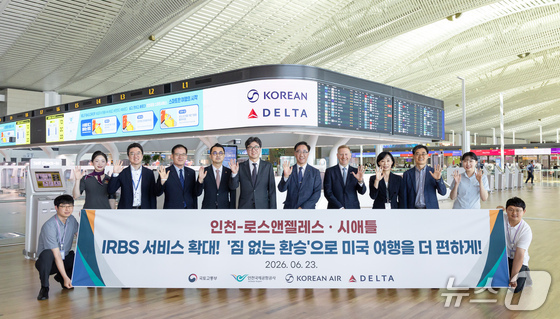
Passengers traveling on Korean Air and Delta Air Lines will experience significantly streamlined baggage screening procedures upon entry into the United States. This is due to the expanded implementation of a system in which U.S. authorities pre-screen baggage images captured prior to arrival. Baggage for passengers transferring to U.S.-bound flights will be automatically transferred to their next flight without requiring re-check-in.
Korean Air and Delta Air Lines announced on Tuesday that they are expanding the International Remote Baggage Screening (IRBS) system to routes departing from Seoul (Incheon) to Seattle and Los Angeles (LA) in the U.S.
IRBS is a system in which X-ray images of baggage bound for the U.S. are transmitted remotely from the departure airport to U.S. Customs and Border Protection (CBP), where CBP analyzes the images in advance. This allows baggage to be screened in the U.S. while passengers are en route to their destination. Passengers on these flights are exempt from random baggage inspections and customs checks upon arrival at U.S. airports, enabling them to clear immigration more quickly.
When transferring in the U.S. on a flight operating the IRBS, the baggage re-check procedure at the first stopover airport in the U.S. is eliminated. This is the so-called Seamless Baggage Transfer (SBT) service, in which the passenger’s baggage is automatically transferred to the final destination airport. This can save up to 20 minutes in transfer time, allowing for a more relaxed journey.
In particular, the convenience for travelers transferring in Seattle is expected to improve significantly. Currently, transferring there requires going through the processes of △arriving at the airport △collecting luggage △going through immigration △and re-checking luggage for the connecting flight, which takes a long time. In contrast, when using flights participating in the IRBS program, transfer passengers can go through immigration immediately upon arrival at the airport and board their connecting flight.
With this expansion of the IRBS program, Korean Air and Delta Air Lines can now offer customers a seamless journey at five major U.S. hub airports—Seattle and Los Angeles, in addition to Atlanta, Detroit, and Minneapolis. This benefit applies not only to passengers departing from Incheon but also to those from other countries and regions transiting through Incheon. For connecting passengers, all they need to do is check their luggage at the initial departure airport and retrieve it at the final destination.
Ko Kwang-ho, Head of Korean Air’s Passenger Business Division, said that Korean Air is expanding connectivity between Korea and the U.S. based on the joint venture partnership with Delta Air Lines, adding that it will continue to strive to provide customers with a more convenient and consistent premium travel experience centered on the Incheon International Airport hub.
Jeff Moomaw, Delta Air Lines’ Executive Vice President for Asia-Pacific, said that the SBT service significantly simplifies the transfer experience for customers traveling to the U.S. He added that by expanding the service to Seattle and Los Angeles, customers will be able to make even better use of their layover time.
Korean Air and Delta Air Lines, as airlines participating in the IRBS project—a collaboration between the South Korean and U.S. governments—launched the service on the Seoul (Incheon) to Atlanta route last August. Since then, the service has expanded to five major U.S. hub airports, starting with Detroit and Minneapolis last April and, as of today, extending to Seattle and Los Angeles.
Surveys have shown that passenger convenience has improved since the introduction of IRBS. The time spent interacting with customs officials upon arrival at U.S. airports has been reduced by more than 65%, and a significant number of passengers whose connecting flights were previously delayed due to baggage re-check procedures have successfully boarded their connecting flights. The two airlines plan to explore ways to expand the service to other international airports in the future.