

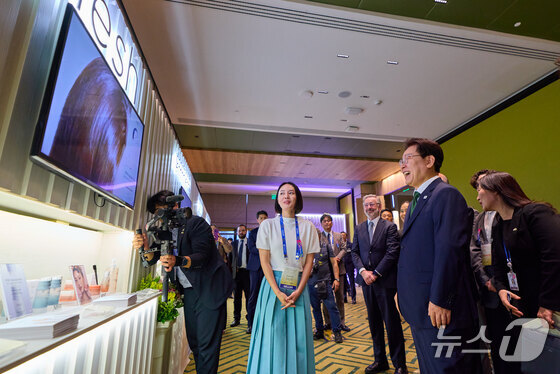
K-beauty has taken center stage in South Korea’s economic diplomacy. As Brazil has emerged as the world’s third-largest cosmetics market, executives from leading Korean beauty companies joined President Lee Jae Myung’s economic delegation during his trip to Latin America, while the government has stepped up regulatory cooperation to support expansion into the region.
By contrast, South Korea’s botulinum toxin industry, which has already proven its competitiveness in the same market, faces a different reality. Companies must undergo months-long government approval procedures each time they expand overseas because of regulations that have designated the technology as a national core technology for the past 16 years. Industry observers say the government is promoting K-beauty exports while K-botox remains constrained by outdated regulations.
Brazil, Latin America’s Largest Botulinum Toxin Market, Already Embraces K-Botox
According to industry sources on July 31, President Lee Jae Myung is visiting Brazil, Chile and Argentina from July 26 to 31. The economic delegation includes executives from major Korean beauty companies, including Lee Sang-mok, president of Amorepacific Holdings; Kim Byung-hoon, CEO of APR; Chun Joo-hyuk, CEO of Goodai Global; and Kim Sung-woon, CEO of Silicon2. Industry officials said it is unusual for so many cosmetics companies to be included in an official economic delegation.
Brazil surpassed Japan in 2023 to become the world’s third-largest cosmetics market, according to Euromonitor. The market is projected to reach $34 billion this year. In February, the South Korean government also signed a memorandum of understanding on regulatory cooperation with Brazil’s National Health Surveillance Agency (ANVISA) to support K-beauty exports.
Brazil is the world’s third-largest medical aesthetics market after the United States and China, as well as the largest botulinum toxin market in Latin America. Market research firm Mordor Intelligence projects Brazil’s botulinum toxin market will grow at a compound annual rate of 9.7% to reach $228 million.
South Korean botulinum toxin products have already established a presence in Latin America. Daewoong Pharmaceutical’s flagship product, Nabota, has generated cumulative sales exceeding $667 million and has secured marketing approvals in 69 countries. In Latin America, it has entered 13 of 20 countries and signed a supply agreement worth approximately $120 million with its Brazilian partner last year. Nabota is available in all three countries on President Lee’s itinerary.

K-Botox Classified as Core National Technology, With Approval Taking Four to Six Months
However, domestic regulations remain a major obstacle to overseas expansion. South Korea’s Ministry of Trade, Industry and Energy designated botulinum toxin production processes as a core national technology in 2010 and expanded the designation in 2016 to include bacterial strains. South Korea is the only country that classifies both production processes and strains as core national technologies.
Domestic botulinum toxin companies must obtain ministry approval whenever they export clinical samples, transfer technology or pursue overseas regulatory approvals. They must also undergo a new review not only when entering a new market but also when changing local partners in countries where they already operate.
According to the Korea Pharmaceutical and Bio-Pharma Manufacturers Association, approval procedures tied to the core national technology designation typically take four to six months and can extend to nearly a year. The resulting lost business opportunities are estimated at $60 million to $67 million annually. Industry officials say approval delays of several months can result in missed opportunities to establish an early market presence.
Government Cites National Security, Industry Awaits New Review
Critics argue that the core national technology designation has become ineffective. The U.S. National Institutes of Health’s GenBank database contains more than 2,200 entries related to Clostridium botulinum. A survey conducted by the Korea Citizens Education Association also found that 82.4% of domestic botulinum toxin companies support removing the designation.
The government, however, maintains that both national security and economic considerations must be taken into account. Industry representatives argue that botulinum toxin is already regulated under laws governing biochemical weapons, foreign trade and counterterrorism, making the core national technology designation a redundant layer of regulation.
Attention is now focused on the latest review by the Ministry of Trade, Industry and Energy’s newly restructured Life Sciences Expert Committee. During last year’s parliamentary audit, lawmakers raised concerns about the long tenures of committee members who participated in the original designation. At the time, Industry Minister Kim Jung-kwan said the government would consider improving how the committee operates.
Whether the designation is ultimately lifted will be decided following reviews by the expert committee and the Technology Protection Committee. As this is the first decision to be made by the newly formed expert committee, the industry’s attention is firmly fixed on the outcome.