

Recently, the primary cause of the capsizing incident involving North Korea’s new 5,000-ton-class destroyer has been identified as a problem with the slipway during the side-launching process.
The side-launching method, which involves placing a completed ship horizontally on a carriage and pushing it into the sea using rails, has been largely abandoned in South Korea due to the significant stress it puts on the vessel.
North Korea has confirmed that the accident occurred because the carriage installed for the side-launching malfunctioned. As the bow and stern carriages moved independently, the ship lost balance and capsized, resulting in substantial damage.
North Korea’s insistence on using the side-launching method, despite its risks, likely stems from the lack of infrastructure at the Chongjin Shipyard, which makes conventional bow-first launching challenging.
However, it has been revealed that North Korea’s decision to designate the Chongjin Shipyard as the home port for the new destroyer, despite its limitations, may be rooted in confidence gained from successfully side-launching a 14,000-ton ship there 40 years ago.
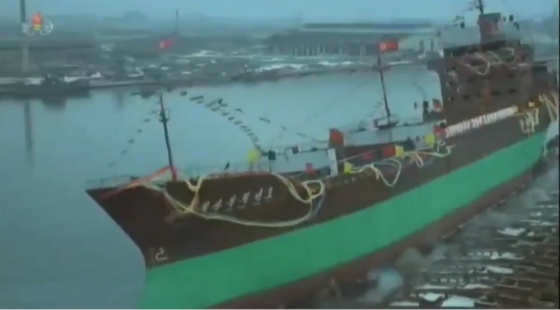
A documentary aired by Korean Central Television in 2019, titled A Brilliant History of Victory Through Self-Reliance, shows footage of the 14,000-ton ship named Chol San Bong Chong Hyon Ho being side-launched at the Chongjin Shipyard.
In the footage, the Chol San Bong Chong Hyon Ho is seen gliding smoothly onto the water’s surface while resting on a rail-mounted carriage.
North Korean documentaries are typically produced to showcase the achievements of the supreme leader or the party. The inclusion of the 1985 launching footage in the 2019 documentary suggests that North Korea still considers this event a significant accomplishment.
The launch of this ship is also documented in the 2020 North Korean Industry report published by the Korea Development Bank. According to this report, the Chongjin Shipyard primarily constructed small fishing vessels until the 1960s. Still, it established itself as a key North Korean port by building cargo ships over 10,000 tons in the 1970s and 1980s. Historical records indicate that the shipyard even produced 20,000-ton cargo vessels and super-large passenger ships.
Notably, the Man Gyong Bong 92, a 12,000-ton passenger ship symbolizing North Korea-Japan exchanges, was built at this shipyard. The Man Gyong Bong 92 also transported North Korean cheerleaders to Busan’s Dadaepo Port during the 2002 Asian Games held in Busan.
However, since the construction of the Man Gyong Bong, there are no confirmed records of large vessel construction at the Chongjin Shipyard following the mid-1990s Arduous March period. It appears that the shipyard has lost its prominence as North Korea shifted focus to other ports, leading to the deterioration of various facilities.
The combination of inadequate infrastructure and North Korea’s characteristic emphasis on “achieving results” may have contributed to this recent accident.
Before the Chongjin Shipyard incident, North Korea successfully launched a 5,000-ton warship at the Nampo Shipyard on the west coast last month. Unlike the side-launching method, they employed the more stable floating dry dock technique, which involves constructing the ship in a dock and filling it with water to float the vessel.