

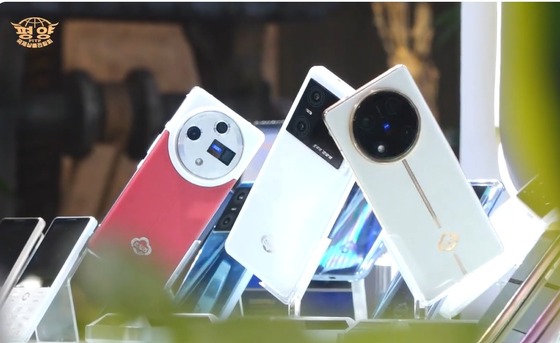
Despite the absence of a free-market system, North Korea’s smartphone market is dominated by the “Jindallae” (Rhododendron) series.
On Monday, North Korea’s monthly magazine Geumsugangsan reported that the popularity of Jindallae phones is “growing by the day,” while highlighting the factory’s production capacity and technical capabilities.
The facility, spanning 6,087 square meters (0.0023 square miles), employs a small-batch, multi-model production system. It produces various types and designs of “intelligent mobile phones” to suit local preferences and aesthetics.
Since its founding in March 2018, the factory has reportedly developed advanced manufacturing equipment in-house through research, including vibration and impact testers. The magazine also praised the plant’s high-level touchscreen technology.
Jindallae is considered one of North Korea’s leading smartphone brands, along with Arirang and Pureun Haneul (Blue Sky). In 2017, the brand introduced its first iPhone-inspired device, the Jindallae 3, and has since produced dozens of models.
Around 2020, the Jindallae 7 was unveiled, incorporating artificial intelligence (AI) features such as fingerprint, voice, and facial recognition, as well as optical character recognition. The company claimed high accuracy for all functions.
Subsequent models, including the Jindallae 10 and 11, followed. The most recent model, the Jindallae 12, was first revealed last month at the 23rd Pyongyang Spring International Trade Fair.
A representative of the Chosun Mangyong Trading Company told the Chongryon-affiliated Choson Sinbo, “The Jindallae 12’s sleek design, color variety, and outstanding features have received very positive feedback from customers.”
North Korea appears to be investing in enhanced AI technology for smartphones while expanding its suite of applications. At the trade fair, the regime also promoted its proprietary messenger app Jindallae 1.0 and a facial recognition program under the same name.
The British broadcaster BBC recently tested a North Korean smartphone and confirmed the presence of built-in censorship features. When composing messages, the device automatically converted South Korean expressions into regime-approved North Korean language or displayed warning alerts.
The BBC recently tested a North Korean smartphone and confirmed the presence of built-in censorship features. When composing messages, the device automatically converted South Korean expressions into regime-approved North Korean language or displayed warning alerts.
For instance, typing “oppa” (a common term in South Korea for an older brother or close male friend) would result in the word being changed to “comrade” or trigger a warning pop-up.
While North Korea encourages citizens to adopt these new IT-equipped smartphones, the regime also appears to be using them as tools for surveillance and tighter social control.