

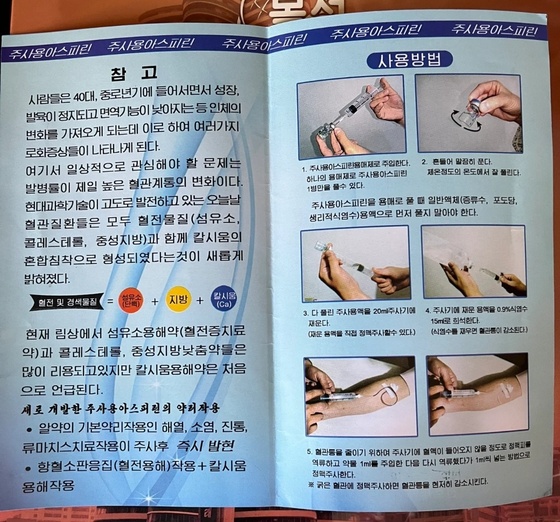
North Korea is promoting the efficacy of injectable aspirin as a new treatment for vascular diseases. However, this method has been phased out in South Korea due to its high risks. On Thursday, analysts suggested that North Korea is pushing this rapid treatment approach despite the dangers associated with its limited supply of medical ingredients.
At last month’s Spring International Commodity Exhibition, North Korea showcased a highly effective medication – injectable aspirin – developed by a preferred pharmaceutical company.
The product description claims that recent research shows that all modern vascular diseases result from the combined effects of thrombotic substances (fibrin, cholesterol, triglycerides) and calcium, which are more likely to develop during aging.
It further states that while fibrinolytic agents and medications that lower cholesterol and triglycerides are widely used clinically, calcium-dissolving agents are a new development. The newly developed injectable aspirin reportedly provides immediate effects, including fever reduction, pain relief, anti-inflammatory action, and rheumatism treatment, as well as thrombus and calcium dissolution following injection.
Typically, during an acute myocardial infarction, the standard treatment involves performing percutaneous coronary intervention (PCI) to open blocked vessels. Before PCI, doctors administer a combination of antiplatelet agents and anticoagulants to prevent blood clot formation. This typically includes oral aspirin (162-325 mg) as an antiplatelet agent and either heparin (administered intravenously) or enoxaparin as an anticoagulant.
North Korea is marketing injectable aspirin as a new drug, despite this method being considered too dangerous for use in South Korea.
Dr. Roh Yong Kyun, a North Korean defector who graduated from medical school in North Korea and now works in the Department of Family Medicine at Hallym University Gangnam Sacred Heart Hospital, explained that in South Korea, it treats myocardial infarctions with angiography, and aspirin is administered orally as a pre-treatment medication, not as an injection.
He added that while injectable medications work quickly, they can cause serious side effects like gastrointestinal bleeding, low platelet count, and allergic reactions. Hence, that’s why they’re not used in South Korea. He further noted that it’s crucial to give aspirin along with other antiplatelet and anticoagulant drugs. Still, North Korea seems to be using injectable aspirin because it struggles to supply these medications effectively.
North Korea has declared this year the “Year of Health Revolution,” with plans to complete the Pyongyang General Hospital, introduce advanced medical technologies nationwide, and establish modern hospitals in rural areas.
However, due to limited resources, North Korea appears to be promoting outdated medical practices as innovative methods, highlighting its ongoing challenges in the medical field.