On Tuesday, just one day before the 73rd anniversary of the Korean War’s outbreak, North Korean territory was visible at the Geumgangsan Observatory, the northernmost observatory on the eastern front in Goseong, Gangwon Province, despite overcast skies.
While the last peak of Mount Geumgangsan, Guseonbong, and Lake Gamho – famous for the “Fairy and the Woodcutter” legend – were visible, what caught the eye was an artificial hill obstructing the Donghae Line road.
An official from the 22nd Division of the ROK Army at the observatory explained that it is a protective barrier erected after North Korea demolished its section of the Donghae Line road.
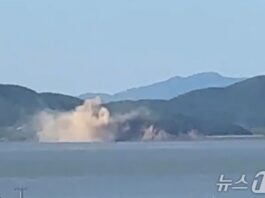
North Korea, maintaining its stance as a separate, hostile nation rather than acknowledging a special relationship, blasted its portion of both the Gyeongui and Donghae Line roads on October 15 last year.
Following this action, North Korea constructed a substantial concrete anti-tank ditch measuring 160 meters (about 525ft) wide, 10 meters long (about 33ft), and 5 meters (about 16ft) deep where the Donghae Line’s railway and road once stood. They also built an 11-meter (about 36ft) high embankment in the surrounding area.
The contrast along the Donghae Line road is stark. The South Korean side near the Geumgangsan Observatory is well-maintained with regularly spaced streetlights, while the North Korean portion resembles abandoned terrain.
Military sources report that beyond the anti-tank ditch, out of direct line of sight, additional structures have been erected to impede North Korean personnel movement.
The Donghae Line road once facilitated land-based tourism to Mount Geumgangsan. However, following the 2008 shooting of a South Korean tourist by North Korean soldiers, the tourism program was suspended. The road has remained non-functional for 17 years.

Shifting focus westward from the East Sea coast revealed one of the South Korean military’s guard posts (GP). While most frontline GPs of South Korea were dismantled under the Pyongyang Joint Declaration of September 2018, the one near the Geumgangsan Observatory was preserved. With North Korea’s violation of the agreement, the South Korean military forces have reactivated this GP.
Just hundreds of meters from the preserved GP of South Korea, the North Korean flag could be seen waving at its post. Nearby stands a North Korean observation point, reportedly visited by Kim Il Sung, Kim Jong Il, and Kim Jong Un to oversee artillery drills.
A South Korean military official noted that while North Korean troops weren’t visible on that day, the area near the Donghae Line was the site of a defection last year. He added that North Korean soldiers are occasionally observed harvesting fish and shellfish from Lake Gamho.
The Geumgangsan Observatory, a critical security point located 800 meters (about 0.5 miles) north of the Southern Limit Line and just 1 kilometer (about 0.62 miles) from the DMZ, reopened last month to veterans’ organizations and student groups after years of restricted civilian access.
Designated as a military facility 717OP, the observatory remains staffed by the ROK Army personnel. This marks the first media visit since North Korea’s destruction of the Donghae Line road.
Although the road remains severed, the area has changed since South Korean President Lee Jae Myung took office. In response to South Korea’s cessation of loudspeaker broadcasts, North Korea has also halted its propaganda broadcasts. The impact was minimal due to the low quality of North Korean speakers and the absence of nearby residents.
An official from the Goseong Unification Observation Tower emphasized the reality of division and the critical importance of national security in the restricted areas near the DMZ, underscoring that the South Korean military must maintain unwavering readiness even if inter-Korean dialogue resumes.