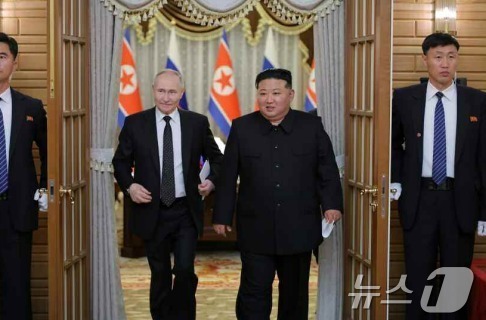
As North Korea and Russia intensify their close cooperation across multiple fronts, the argument that sanctions against North Korea are ineffective is gaining traction. Both countries have blatantly continued to violate sanctions, with their governments openly acknowledging troop deployments and even releasing photographic evidence of sanctions violations in official settings.
On June 29, North Korea hosted a performance to commemorate the first anniversary of the North Korea-Russia treaty, inviting the Russian Minister of Culture, Olga Lyubimova. For the first time, North Korea officially showcased images of its military personnel deployed to Russia. Additionally, footage captured Secretary Kim Jong Un gently touching a casket draped in the North Korean flag, presumably containing the remains of a fallen North Korean soldier.
North Korea’s extensive propaganda surrounding its troop deployment potentially violates United Nations Security Council resolutions. Resolutions 1718 and 2375 prohibit the use of North Korea’s military force overseas. The act of deploying troops itself constitutes illegal arms trading and human rights violations, yet North Korea appears to be openly emphasizing these actions.
Since signing the Comprehensive Strategic Partnership Treaty in June last year, both the North Korean and Russian governments have claimed that their sanction violations are legitimate acts of cooperation between nations. This trend has intensified since April this year, when both countries officially revealed the deployment of North Korean troops in Kursk last year.
Furthermore, Russia announced last month that North Korea would send an additional 1,000 engineers and 5,000 military construction personnel. While this is framed as support for construction site labor, it also violates sanctions. Security Council Resolution 2375 prohibits new employment permits for North Korean workers, and Resolution 2397 mandates the repatriation of North Korean workers by UN member states.
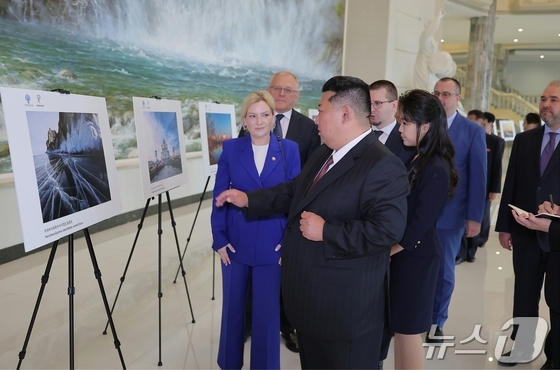
Sanction violations continue beyond the military sector, extending into cultural exchanges.
Minister Lyubimova recently announced on her Telegram account that, following her visit to North Korea, a new agreement has been reached, and the Mansudae Art Studio will hold an exhibition at the All-Russian Museum of Decorative, Applied, and Folk Art in Moscow from August 18 to September 17.
However, the Mansudae Art Studio has been designated as a target of UN Security Council sanctions since 2017. While it remains unconfirmed whether artworks from the studio will lead to sales after the exhibition, if this occurs, North Korea could potentially generate foreign currency.
The recent inauguration ceremony for the Wonsan-Kalma Coastal Tourist Area further underscores the argument against the effectiveness of sanctions. The lavish resort and luxury brands adorning Kim Jong Un’s daughter, Kim Ju Ae, and his wife, Ri Sol Ju, suggest that obtaining construction materials and high-end goods is possible despite sanctions.
Adding to these challenges, the termination of the UN expert panel’s activities due to Russia’s veto in April last year has become a significant obstacle to enforcing sanctions against North Korea. Although a Multinational Sanctions Monitoring Team (MSMT), composed of 11 countries including the U.S., Japan, and South Korea, was established last October to replace the function of monitoring the implementation of sanctions against North Korea carried out by the previous expert panel, its effectiveness is questioned due to low participation rates.
Some analysts argue that the blatant violations of the Security Council’s sanctions mechanism by North Korea, China, and Russia reflect a broader trend of disregard for international sanctions regimes.