North Korea is actively working on support measures to prevent a decline in birth rates, including a five-year plan that favors families with multiple children.
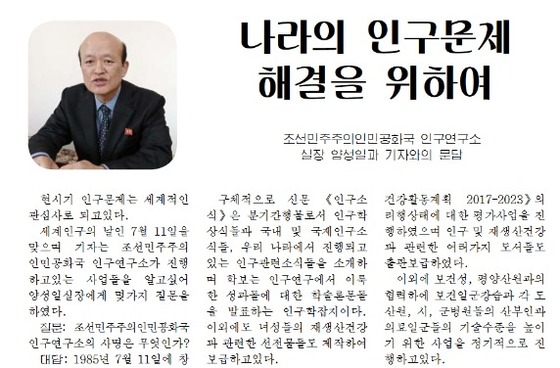
The July issue of Geumsugangsan, North Korea’s monthly magazine for external propaganda, published an interview with Yang Sung Il, head of the North Korean Population Research Institute, ahead of World Population Day on Friday. The institute, established in 1985, is celebrating its 40th anniversary this year, marking four decades since its affiliation with the United Nations Population Fund.
Yang explained that the institute studies trends in birth rates and labor force changes, forecasts future developments, examines influencing factors, and proposes demographic strategies to address population aging, submitting them to relevant agencies for sustainable development.
He noted that the institute has contributed to policies encouraging women to have more children and favoring families with multiple children to prevent declining birth rates.
Yang stated that they have established special subsidies for families raising three or more children, which they believe will be beneficial in real life. They are continually implementing favorable measures for these families across various sectors, including commerce, convenience services, education, and healthcare. Additionally, they plan to collaborate with the Ministry of Public Health to develop the National Reproductive Health Activity Plan 2026-2030.
He said that the institute is currently conducting in-depth projects to evaluate children’s growth and development, assess the population’s disability rate, and work on urban and industrial planning in close coordination with workers and officials from various sectors.
North Korea, facing a serious low birth rate issue similar to South Korea’s, seems to be increasing various benefits for women and families with multiple children to boost its birth rate.
According to an article reported in Rodong Sinmun last March, North Korea has reduced working hours for women raising two or more children under eight years old and doubled their regular vacation periods. Additionally, women who give birth to more than one child can take maternity leave followed by a period of leave from work.
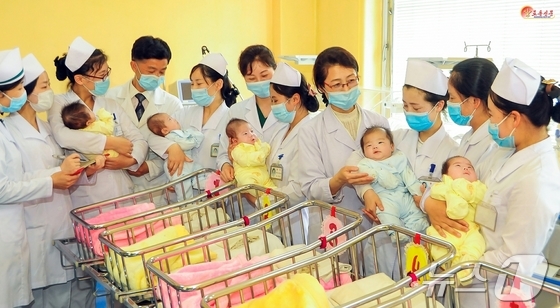
Last month, North Korea announced that a family welcomed the country’s first set of quintuplets in January, boasting that the family has enjoyed the best privileges since their birth. North Korea also heavily promotes each instance of triplets being born, seemingly to showcase Kim Jong Un’s regime as one that prioritizes the people under the banner of “people-first” policies while encouraging childbirth.
During local inspections, Kim has personally monitored milk supplies for nurseries and school meals, often emphasizing the roles of women as workers and mothers.
In 2022, North Korea enacted a childcare law guaranteeing that the state would provide children with nutritional foods, such as dairy products, free of charge. Furthermore, at the 5th National Mothers’ Conference held in December 2023, he urged women to contribute more in the economic sector and to have more children to help address the low birth rate issue, thereby maintaining the regime.
According to the 2024 Key Statistical Indicators of North Korea published by Statistics Korea, as of 2023, North Korea’s population stands at 25.78 million, roughly half that of South Korea’s 51.71 million, with a total fertility rate of 1.6, which is 0.88 higher than South Korea’s rate of 0.72.
However, considering North Korea’s labor-intensive economic structure and its significant allocation of population for defense, projections suggest that the trend of population decline may pose an even more critical challenge for North Korea.