North Korea has decided to skip the ASEAN Regional Forum (ARF) Ministerial Meeting scheduled for Friday in Malaysia.
The ARF, comprising 27 nations including the ten ASEAN countries, the U.S., Japan, South Korea, China, and Russia, is the only multilateral security forum in which North Korea participates. This marks North Korea’s first absence since joining as the 23rd member in 2000.
The primary reason for North Korea’s non-attendance appears to be its severed diplomatic ties with Malaysia following the assassination of Kim Jong Nam.
The incident, which occurred in 2017 at Kuala Lumpur International Airport, involved North Korean agents deceiving women from Vietnam and Indonesia into a fake TV shoot to assassinate Kim Jong Nam, the half-brother of North Korean leader Kim Jong Un, using VX nerve agent. The event caused significant international uproar.
In response, Malaysia actively enforced sanctions against North Korea, including the extradition of a North Korean businessman to the United States, leading to a complete breakdown in diplomatic relations between the two countries.
Some analysts suggest that North Korea’s ARF absence may also be a strategic move to avoid contact with South Korea, the United States, and Japan, given their current strained relationships.
Often dubbed the “mini UN,” the ARF has been a stage for North-South rivalry. North Korea typically used the forum to justify its nuclear and ballistic missile programs, while South Korea, in alliance with the U.S. and Japan, focused on condemning these actions.
The ARF once served as a multilateral platform for peace and cooperation on the Korean Peninsula.
Following the first inter-Korean summit in June 2000, the 8th ARF held in Vietnam in 2001 saw member countries emphasizing the importance of a second inter-Korean summit and encouraging both Koreas to maintain their peace initiatives.
Whether marked by competition or cooperation, the ARF has been one of the few international venues where high-ranking officials from both Koreas could interact, making these encounters a key point of interest.
After joining the ARF in 2000, North Korea initially sent its foreign minister, mirroring the approach of other nations. However, following the collapse of denuclearization talks in 2019 and the onset of the COVID-19 pandemic, North Korea has signaled its waning interest by delegating its ambassadors to nearby countries instead.
Nevertheless, South Korea has consistently sought to use the ARF as an opportunity for brief encounters with North Korean officials. These interactions, when they occur, often amount to mere formalities or are met with outright disregard from the North Korean side.
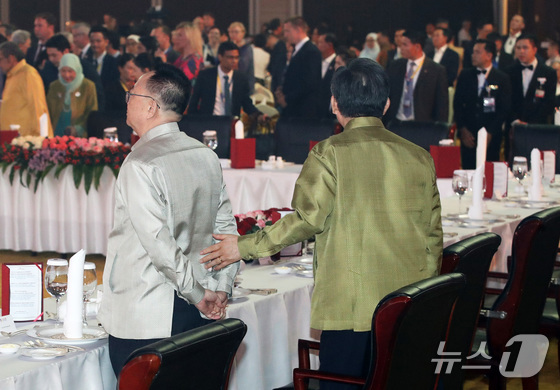
At last year’s ARF dinner, South Korean Foreign Minister Cho Tae Yul approached North Korea’s ambassador to Laos, Ri Yong Chol, in an attempt to engage. However, Ri rebuffed the gesture, turning away with his arms folded.
Later, Minister Cho told reporters that Ri didn’t even look at him when he tried to engage him, adding that he just came back because he couldn’t hold on to someone who wouldn’t respond.