North Korea’s nuclear capabilities have evolved beyond mere possession to a systematic and stable production capacity, prompting experts to call for negotiation strategies aimed at curbing production itself.
According to a report titled “Analysis of Recent Changes in North Korea’s Nuclear Weapons Production Capability and Considerations for Denuclearization” by Lee Sangkyu, chief of the Nuclear Strategy Research Division at the Korea Institute for Defense Analysis (KIDA), North Korea has been steadily expanding its nuclear arsenal since Kim Jong Un’s 2023 directive to exponentially increase nuclear warhead stockpiles.
Lee cites the expansion of nuclear facilities at the Yongbyon complex, a strategic hub for military-grade highly enriched uranium (HEU) production, and the Kangson facility, a suspected undisclosed uranium enrichment site, as evidence of this trend.
According to the report, satellite imagery has consistently revealed construction of what appears to be an unprecedented large-scale nuclear material production facility at Yongbyon. This new facility reportedly bears similarities to the Kangson complex, another uranium enrichment site.
Lee notes that the rectangular layout and auxiliary infrastructure of the new building align with design criteria for centrifuge cascade installation. He suggests the building’s width could accommodate at least two parallel enrichment lines, indicating plans for large-scale HEU production.
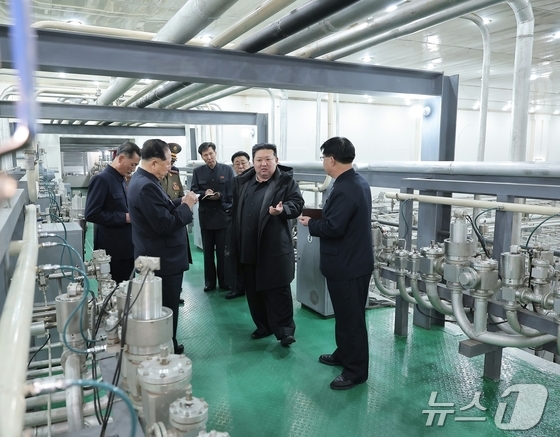
The Kangson facility, which is believed to house numerous centrifuge cascades, has also shown signs of expansion in satellite imagery around 2024. Photos released by Korean Central News Agency on September 17, 2024 of Kim Jong Un inspecting nuclear facilities reveal sophisticated control systems and parallel centrifuge cascades, suggesting more advanced capabilities than those at Yongbyon.
Based on available data, the report estimates North Korea could produce 127-150 nuclear weapons annually, including both uranium and plutonium warheads, by 2025.
Lee projects that if this production trend continues, North Korea could theoretically possess 201-243 warheads by 2030 and 344-429 by 2040. These figures, accounting for current enrichment facilities, mineral resources, and dispersed operations, indicate North Korea’s potential to develop a sophisticated nuclear force structure.
Given North Korea’s transition from mere nuclear possession to systematic production expansion, Lee emphasizes the need for a risk reduction strategy in future negotiations to limit North Korea’s nuclear capabilities and advance denuclearization efforts.
While maintaining complete, verifiable, and irreversible denuclearization (CVID) as the ultimate goal, Lee argues that negotiations should focus on quantitative production limits and implementing robust international verification systems to slow North Korea’s nuclear progress.
Lee concludes that North Korea views its nuclear capabilities as a political and diplomatic tool, not just a matter of possession. He urges swift action to explore early agreements or partial freezes to limit production, recognizing the urgency of addressing North Korea’s expanding nuclear program.