

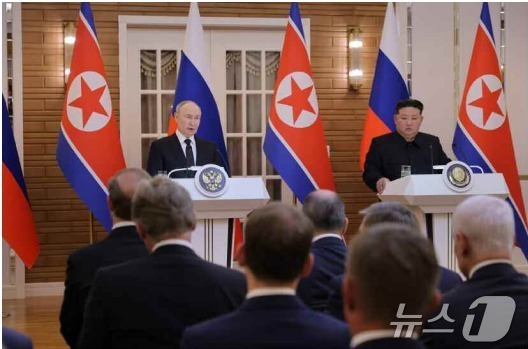
An analysis has emerged showing that Russian state media has significantly increased its coverage of relationships with North Korea, China, Iran, and Belarus since the start of the Ukraine war.
On Wednesday, NK News, a U.S.-based media outlet specializing in North Korea, reported that Russian state media has shown an unprecedented interest in North Korea amid active bilateral relations, citing a report from OpenMinds.
According to the report, while Belarus has been a long-standing ally consistently featured in Russian state media from 2021 to 2025, mentions of China, Iran, and North Korea have nearly doubled on average annually.
The report revealed that Russian state media published only 15 articles covering cooperation with North Korea in 2021, but that number surged to 1,604 in 2024, averaging about 134 articles per month.
The study employed a large language model to filter keywords containing nouns and adjectives referring to these three countries, analyzing cooperation between Russia and these nations.
Additionally, the report noted that Russian tourism-related media content has shifted its focus from Turkiye and Egypt—long-popular destinations for Russian travelers—to China and North Korea.
This shift was attributed to articles promoting new train routes to Pyongyang and the development of tourism zones in North Korea exclusively for Russian tourists, including the newly opened Wonsan Kalma Beach Resort.
The report also highlighted youth diplomacy between North Korea and Russia as the Kremlin’s new soft power strategy, citing extensive coverage of the first visit by Russian children to North Korea’s Songdowon International Children’s Camp last August. It noted that this visit was widely shared on Telegram channels, portraying North Korea as both welcoming and modern.
However, some experts cautioned against overinterpreting this series of reports from Russian state media as a sign of closeness among pro-Russian countries.
Bruce Bennett, a senior international and defense researcher specializing in Northeast Asia at the RAND Corporation, characterized the trend in Russian state media’s North Korea coverage as part of Moscow’s strategic shift. He argued that although all four countries (North Korea, China, Iran, and Belarus) share a desire to weaken U.S. global influence, they remain extremely wary of one another.
Chris Monday, a Russian studies researcher at Dongseo University, stated that while Russia, China, Iran, and North Korea are growing closer, it is impossible to categorize them all in the same way. He asserted that Russia-North Korea relations represent one issue, China-North Korea relations another, and Russia-China relations a third.