

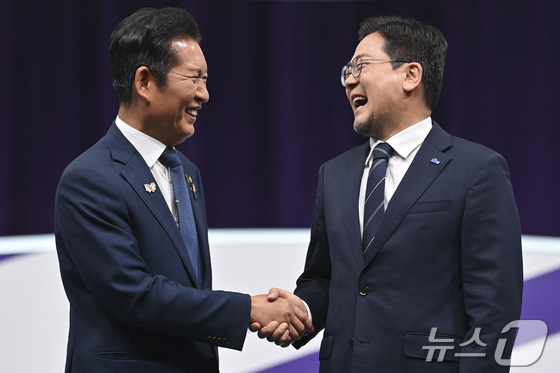
Democratic Party of South Korea leadership candidates Jeong Cheong Rae and Park Chan Dae called for a robust response to China’s repeated unauthorized installations of artificial structures in the Yellow Sea’s Yellow Sea’s provisional measure zone (PMZ).
They stressed the need to resolve historical issues before normalizing South Korea-Japan relations and advocated inviting North Korean leader Kim Jong Un to the upcoming Asia-Pacific Economic Cooperation (APEC) summit in Gyeongju this October.
The candidates participated in their final TV debate for the August 2nd National Party Convention on MBC’s 100 Minute Debate program in Seoul. This debate particularly highlighted their perspectives on foreign policy and national security.
Both candidates unanimously called for a firm response to China’s PMZ project, which involves the installation of artificial structures.
Park asserted that there’s no room for compromise when it comes to national interests, emphasizing the need to respond forcefully. He explained that they need to be especially resolute on territorial issues to prevent encroachment.
Park also stated that while U.S.-China tensions over Taiwan persist, they must strategically leverage the situation. He explained that China would face significant challenges if it engaged in conflicts with both Taiwan and South Korea simultaneously.
Jeong remarked that while China is a crucial trading partner and we should maintain positive relations, they cannot tolerate the Northeast Project. He expressed his dismay at China’s interpretation of Goguryeo history, stating that he was shocked and deeply offended to hear them portray Goguryeo’s history as part of their own during discussions about the Gwanggaeto Stele.
He further stated that they must take strong action on this issue from a maritime sovereignty perspective, emphasizing the need to separate politics, economics, and territorial integrity.
Both candidates agreed that addressing historical grievances should precede the normalization of South Korea-Japan relations.
Jeong insisted that they must maintain pressure on Japan, which has not taken a proactive stance on issues like Dokdo and comfort women. He explained that while President Lee Jae-myung considers the need for negotiating while fighting, Democratic Party must continue to demand Japan’s apologies and assert the territorial sovereignty of South Korea over Dokdo.
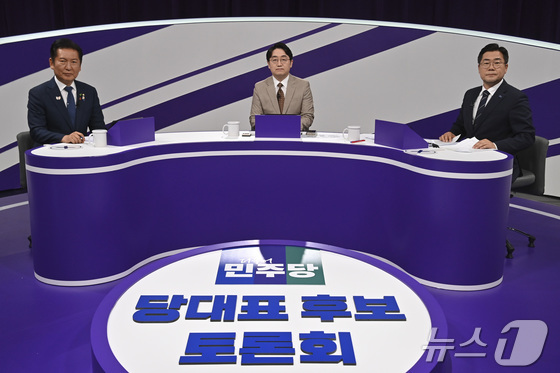
The candidates also concurred on the need to invite Kim Jong Un to the APEC summit to ease inter-Korean tensions
Park stated that they should definitely extend the invitation. He explained that regardless of whether Kim accepts, they need to approach inter-Korean relations with patience and a willingness to engage in dialogue. He further stated that they need to be proactive on North-South issues to ensure that South Korea isn’t sidelined in regional discussions.
Jeong emphasized that they need to break down the psychological barriers that exist between the North and South. He explained that they must persistently pursue dialogue in order for South Korea not excluded from the talks.
Jeong suggested that while it’s ultimately up to North Korea to decide whether to attend, they should extend the invitation regardless. He explained that the U.S. President Trump is likely to attend the summit in Gyeongju, but even if he can’t, they should consider facilitating a meeting at Panmunjom, similar to what occurred during the Moon Jae-in administration.
Regarding U.S. Forces Korea’s defense cost-sharing negotiations, Park advocated for firm negotiation tactics, stating that they need to stand their ground and resist unreasonable demands. He stressed that they should address security matters, defense costs, and trade tariffs as separate issues.
Both candidates agreed on several other points: opposing new nuclear power plants, supporting the issuance of a Korean won stablecoin, maximizing national fiscal spending, and building public consensus before implementing anti-discrimination laws.
During the debate, the candidates reiterated their commitment to ending rebellion and reforming the prosecution, media, and judiciary, while criticizing former President Yoon Suk Yeol and the People Power Party. They even hinted at the possibility of unilateral action if the opposition resists these reforms.
While emphasizing their close relationship with terms like “comrade” and “friend,” the candidates engaged in subtle rivalry. Park’s critiques of Jeong, who had previously defeated him in two regional primaries, were particularly noteworthy.
Park highlighted the disparity in voting power at the party convention, where delegates have 17 votes compared to regular members’ single vote. He advocated for the one-person, one-vote policy while maintaining the delegate system. Jeong responded that the issue lies in the timing and pace of its implementation.
After the debate, Park questioned whether the party leader could unilaterally decide on such changes.
Park also emphasized his meticulousness compared to Jeong, claiming a comparative advantage in political engagement and sensitivity. He notably mentioned during the debate that the Golden Cross has already begun.
Jeong later expressed disappointment in Park’s suggestion to adjust the pace of implementing the one-person, one-vote policy. He acknowledged Park’s growth, stating that despite his shorter political tenure, Park’s understanding of foreign policy and national security has broadened and deepened considerably.