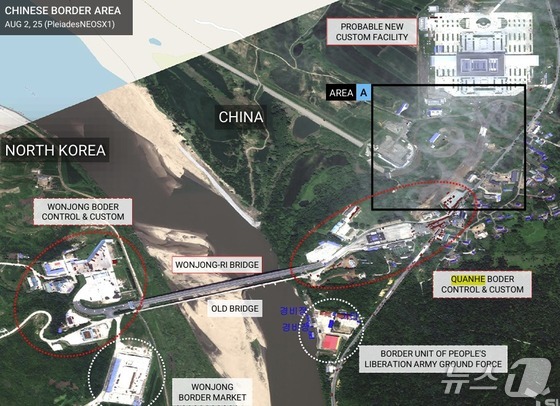
Recent satellite imagery reveals China’s plans to open a large-scale customs facility near Hunchun, a city bordering North Korea. This development, reported by SIA on Monday, a South Korean satellite image analysis company, suggests significant implications for regional dynamics.
Analysts suggest that China’s move serves a dual purpose: to strengthen its influence over North Korea while simultaneously countering the expanding ties between North Korea and Russia.
SIA’s report, titled, China’s Efforts to Access the Pacific from the Northeastern Region, sheds light on this strategic development.
While 70% of North Korea–China trade currently flows through Sinuiju and Dandong, the new Hunchun facility aims to boost trade with the Wonjong-ri area in Rason, North Korea.
Interestingly, this customs facility, completed in 2020 after a two-year construction period, has remained unused for five years.
Rason, located at North Korea’s northeastern tip and bordering both China and Russia, was designated a special city in 2010 to attract foreign investment and expand international trade in an effort to alleviate its economic challenges.
The opening of the New Tumen River Bridge in 2016 connected Wonjong-ri and Hunchun, followed by the establishment of the Wonjong-ri International Market in Rason in 2018, targeting Chinese consumers.
However, international sanctions against North Korea led to a sharp decline in tourism, and the COVID-19 pandemic effectively halted operations from 2020 onward.
This year, both nations have shown interest in reviving trade in the area. Similarly, the New Yalu River Bridge, completed in 2014 to commemorate 75 years of North Korea–China diplomatic relations, is now witnessing renewed construction activity after a decade of neglect.
The report suggests that an active route between Rason and Hunchun could facilitate North Korean coal and seafood exports to China, while also providing China with direct Pacific access via Rajin port for its northeastern logistics.