

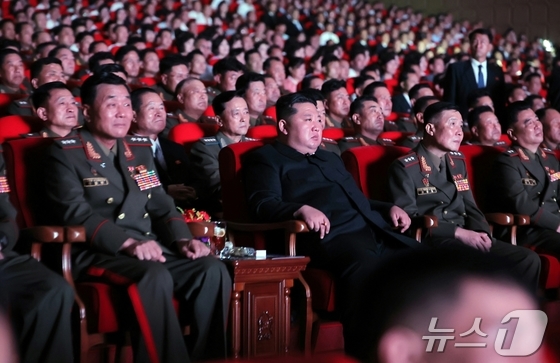
North Korea recently released new songs honoring soldiers who died while deployed in the Ukraine war. Analysts suggest that this goes beyond mere commemoration, serving as a new heroic myth aimed at rallying the younger generation.
On August 22, Korean Central Television aired a recording of a Congratulatory Performance for Commanders and Combatants of the Korean People’s Army Overseas Operation Unit lasting about 80 minutes. The broadcast began with Kim Jong Un, General Secretary of the Workers’ Party, laying flowers before a Wall of Remembrance adorned with portraits of heroes who fell during a national commendation ceremony at the Party Central Committee headquarters.
After the flower-laying ceremony, Kim entered the April 25 House of Culture. The audience, including both civilians and military personnel, rose to greet him with enthusiastic applause before the main performance began. North Korea presented 11 songs, starting with the national anthem and including propaganda tunes such as “The Fate of My Homeland and Me,” which was unveiled earlier this year.
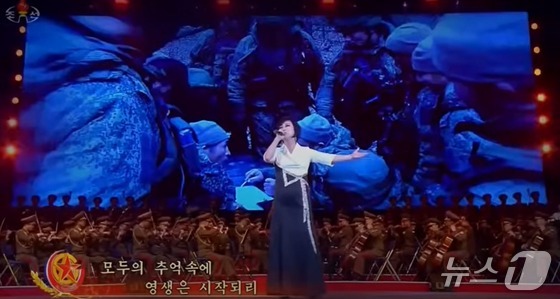
The highlight of the performance was a video montage featuring veterans deployed to Russia, along with three new songs honoring fallen soldiers. The 20-minute video showed North Korean troops—first deployed to the Kursk region last October—conducting winter operations. It also revealed Kim’s New Year’s letter to troops abroad, expressing both gratitude and encouragement.
Following the video, the stage debuted songs including “Stars of the Homeland,” “I Will Remember,” and “Only Victory.” Throughout the performance, the backdrop displayed combat footage and phrases summarizing soldiers’ heroic deeds. The audience responded emotionally, with some wiping away tears or embracing one another.
Experts noted that the lyrics suggest North Korea is not merely commemorating the sacrifices of its deployed soldiers but is launching a campaign of heroization to foster internal unity.
For instance, “Stars of the Homeland” refers to fallen soldiers as shining stars safeguarding national dignity and honor. It promises that their costly sacrifice will not be forgotten and speaks of an eternal life beginning in collective memory, thereby implying a heroic status.
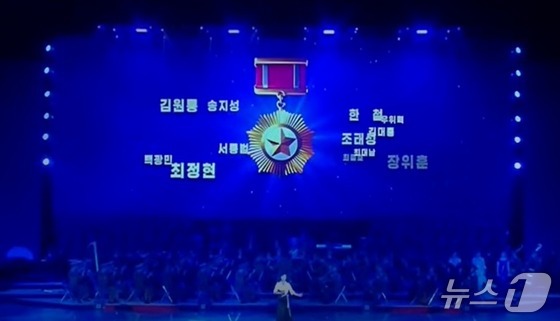
North Korea’s comprehensive approach—including installing the Wall of Kimemembrance, producing video montages, creating new songs, and staging a grand performance—targets the Jangmadang Generation (those born in the 1980s–1990s) as well as future generations, who are heavily influenced by cultural trends.
The broadcast strategically alternated between shots of a young boy watching the performance and visuals of deployed soldiers’ names and medals, emphasizing the songs’ message for future generations. Oh Kyung-seop, a senior researcher at the Korea Institute for National Unification, stated that by releasing three memorial songs, North Korea demonstrated a strong commitment to glorifying the deployment. Further noting that they strategically employed popular songs that may resonate with younger generations, who are more exposed to external influences such as Korean dramas and music than older cohorts.