

This week, North Korean leader Kim Jong Un stands alongside Chinese President Xi Jinping and Russian President Vladimir Putin atop the Tiananmen Square in Beijing, China.
According to multiple government sources, Kim departed Pyongyang on the afternoon of Monday aboard his private train, the Taeyang-ho. The distance from Dandong to Beijing is about 1,000 km (about 620 miles). Given the train’s average speed of 50-60 km/h (about 31-37 mph), it is expected to arrive in Beijing by the morning of Tuesday.
North Korea’s state-run Korean Central News Agency reported unusually quickly on Tuesday 2 that Kim had left the previous day by private train. They noted that Foreign Minister Choe Son-hui and other party and government leaders were accompanying him on this visit.
Kim plans to attend the 80th anniversary celebration of Victory Day (commemorating the victory in the anti-Japanese and anti-fascist wars) on Wednesday in Beijing, where he will stand alongside Xi and Putin atop the Tiananmen Tower.
According to the Kremlin, Kim will stand to Xi’s left, with Putin on Xi’s right.
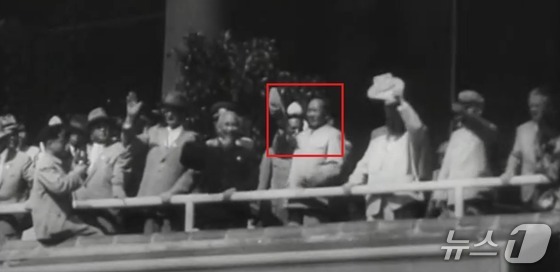
This marks the first time in 66 years that the leaders of North Korea, China, and Russia have gathered in one place. On October 1, 1959, Kim Il Sung attended a military parade celebrating the 10th anniversary of the founding of the People’s Republic of China, standing atop the Tiananmen Tower alongside major communist leaders, including Chinese President Mao Zedong and Soviet Communist Party Secretary Nikita Khrushchev.
However, this year marks the first time that the North Korean, Chinese, and Russian leaders will stand together.
During the 1959 event, Mao stood in the center, with Khrushchev to his left and Ho Chi Minh, the first President of Vietnam, to his right. Kim Il Sung stood fourth from Mao’s left.
Analysts suggest that this arrangement reflected both the strategic alliance and diplomatic symbolism of North Korea, China, and the Soviet Union during the Cold War.
North Korea has maintained close ties with China, its blood ally, since the Korean War, based on their ideological similarities. It is reported that Kim Il Sung visited China over 40 times, including both public and secret visits, following the establishment of diplomatic relations between the two countries in October 1949.
Even after Kim Il Sung’s death and the establishment of Kim Jong Il’s regime in September 1998, North Korea continued to strengthen its relationship with China.
Kim Jong Il made his first visit to China in May 2000, just before the first inter-Korean summit, and visited China eight times until his death in 2011. Chinese Presidents Jiang Zemin and Hu Jintao also visited North Korea, fostering friendly relations between the two countries.
However, unlike Kim Il Sung, Kim Jong Il did not attend military parades hosted by China or participate in multilateral diplomatic events, leading to his characterization as a reclusive leader.
Diplomatic circles are closely watching whether the trilateral cooperation between North Korea, China, and Russia will solidify following this Victory Day event. There is also interest in the potential for a summit of the three leaders, which could signal the start of a new Cold War.
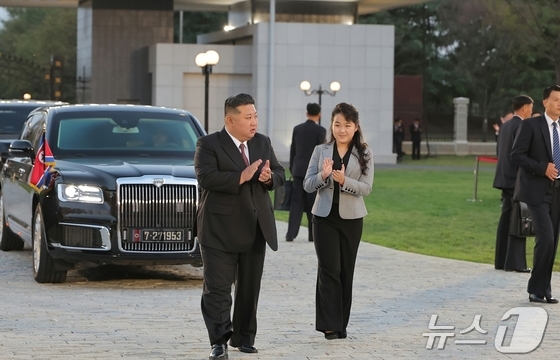
Meanwhile, analysts suggest that Kim’s daughter, Kim Ju Ae, may accompany him to the military parade, which could serve as an indication of her being named as his successor. Showing his child to the Chinese leaders carries significant implications for establishing her as the designated heir.
Kim Ju Ae, who made her public debut in 2022, has recently taken on roles previously held by her mother, Ri Sol Ju, and is expanding her public presence.
Since Kim’s rise to power, he has visited China four times, with Ri accompanying him on three occasions. There is cautious speculation that Ju Ae may visit China this time in place of her mother.
However, some argue that, unlike previous successors who visited China after being designated as heirs, Kim Ju Ae has not yet been officially named as a successor, making the likelihood of her visit this time low.