

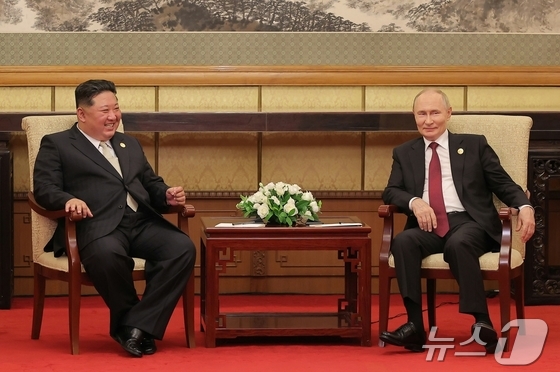
Russian President Vladimir Putin sent a congratulatory message to North Korean leader Kim Jong Un just one day after their summit, once again showcasing the strong ties between North Korea and Russia.
North Korea’s state-run newspaper Rodong Sinmun published the full text of Putin’s letter to Kim on Friday, which was dated the previous day. The letter was sent ahead of the 77th anniversary of North Korea’s founding on September 9.
Putin began his letter by addressing Kim as my dear friend, respected Comrade Kim Jong Un, extending his warmest congratulations on the founding anniversary of the Democratic People’s Republic of Korea.
He continued that 77 years ago, Russia was the first to recognize the new Korean state, adding that since then, the relationship between Moscow and Pyongyang had honorably overcome the trials of time. Russia was indeed the first country to recognize North Korea as a nation on October 12, 1948, during the Soviet era.
Putin remarked that the participation of North Korean combat units in liberating the Kursk region from invaders served as a clear symbol of the friendship and mutual assistance between Russia and North Korea. He also expressed confidence that the two countries would continue to strengthen their comprehensive strategic partnership through joint efforts.
He emphasized that this alliance fully aligns with the interests of the Russian and North Korean people, contributing to security and stability across the Korean Peninsula and Northeast Asia.
Kim and Putin held bilateral talks on Wednesday after attending the 80th anniversary celebration of China’s victory in World War II.
During that meeting, Putin referred to the North Korean troops deployed in Russia, describing the North Korean-Russian relationship as one of special trust, friendship, and alliance. Kim pledged continued full support for Russia, calling it a brotherly obligation. While specific details remain undisclosed, discussions likely covered topics such as compensation for troop deployment, additional forces for reconstruction in the Kursk region, and future cooperation after the conflict ends.