


North Korea announced on Tuesday that it has successfully completed the development of a new missile engine following a series of tests. Previously, the country stated that this new engine would be used in the yet-to-be-unveiled intercontinental ballistic missile (ICBM) known as the Hwasong-20. Analysts expect Pyongyang to conduct a test launch of the new ICBM soon, aiming to demonstrate its internal integration and nuclear capabilities.
The Workers’ Party’s official newspaper, Rodong Sinmun, reported on its front page that the Missile General Bureau of the Democratic People’s Republic of Korea conducted a ground ejection test of a high-output solid-fuel engine, which utilizes carbon fiber composite materials, on the 8th. The report added that Kim Jong Un personally observed the test.
The Korean Central News Agency(KCNA) corroborated this information, referring to it as the final test, suggesting that the development of the new engine has now concluded. The agency also disclosed that the engine’s thrust measures 1,971 kN (kilonewtons), which is capable of lifting about 200 tons (about 440,900 pounds) into the air.
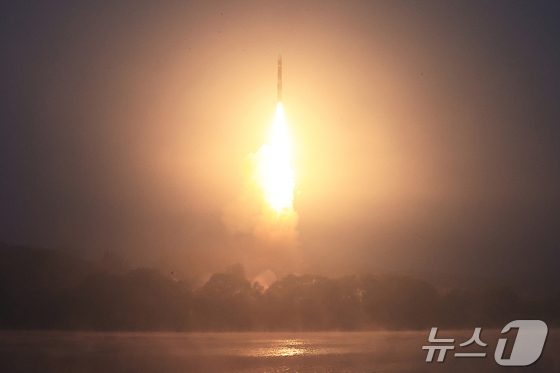
Launch Possible as Early as Next Month; North Korea Aims to Showcase Extended Range and Multiple Warhead Capabilities
On September 1, prior to attending the 80th anniversary of China’s Victory Day celebrations, Kim visited the Chemical Materials Comprehensive Research Institute under the Missile Bureau. There, he reviewed the production processes for carbon fiber composite materials and high-thrust missile engines. At that time, KCNA revealed plans to utilize the newly developed engine for both an upgraded version of the Hwasong-19 ICBM and the new Hwasong-20 ICBM. With the announcement of the engine’s development completion, the only step remaining is an actual launch to confirm its performance.
Defense analysts note that historically, North Korea has conducted ICBM launches within one to four months after announcing the development of a new engine. This pattern leads experts to predict that an ICBM launch could occur as early as next month, possibly coinciding with the 80th anniversary of the Workers’ Party founding. There is also speculation that Pyongyang might conduct test launches of both the upgraded Hwasong-19 and the new Hwasong-20 within this year.
The carbon fiber composite materials emphasized by North Korea are known for their lightweight properties, high strength, and ability to withstand extreme temperatures. Utilizing these materials in engine casings could significantly reduce weight while enhancing durability. Experts believe this technology will allow North Korea to simultaneously pursue two strategic goals: extending missile range and securing multiple independently targetable reentry vehicle (MIRV) capabilities.
If the development of the engine using carbon fiber composite materials proves successful, it could substantially reduce the size and weight of fuel tanks, thereby facilitating extended range for launch vehicles. Even after deploying multiple warheads, North Korea could maintain its desired strategic range.
Additionally, the new engine is likely to be applicable not only to ICBMs but also to new launch vehicles for reconnaissance satellites. Since North Korea launched its first military reconnaissance satellite in November 2023, it has not conducted any further launches. Given the similar operational principles of ICBMs and space launch vehicles, North Korea is expected to resume satellite launches leveraging this new engine technology.
Professor Lim Eul-chul from Kyungnam University’s Institute for Far Eastern Studies stated that carbon fiber solid engines can enhance the range and accuracy of small satellite launch vehicles or ICBMs by increasing efficiency and reducing weight compared to traditional metal-based engines. Further noting that the cost-effectiveness and performance of carbon fiber materials will enable sustainable weapons development despite international sanctions against North Korea.
Strengthening Internal Cohesion While Solidifying Ties with China and Russia to Normalize its Nuclear Status
North Korea’s decision to unveil the new engine development at this juncture appears to be influenced by both domestic and international political considerations.
This year marks the 80th anniversary of the Workers’ Party founding (October 10), a symbolically significant milestone during which North Korea has focused on consolidating internal unity since the beginning of the year. Concurrently, it is the final year of the five-year defense enhancement plan presented at the 8th Party Congress in 2021, necessitating a display of related achievements.
On the international front, the move seems calculated to send messages to those North Korea considers hostile nations, such as South Korea and the U.S., while also preparing for potential future negotiations. After launching the Hwasong-15 ICBM in November 2017 and declaring the completion of its national nuclear force, North Korea shifted its external strategy toward dialogue and negotiations starting in January 2018.
While North Korea claimed that the Hwasong-19 was the final version when it was launched last year, the recent mention of the new Hwasong-20—followed by speculation about a possible second Donald Trump administration—suggests to many experts that this is not merely a continuation of defense enhancements.
Furthermore, North Korea’s recent participation in China’s Victory Day celebrations and its display of close ties with China and Russia indicate an intention to normalize its status as a nuclear power within the international community.
Hong Min, a senior researcher at the Korea Institute for National Unification, remarked that North Korea’s ICBM development is a highly sensitive issue for China. He noted that the bold actions surrounding Victory Day suggest that China may have reached some form of understanding or tacit approval regarding North Korea’s missile development. Further stating that even without China’s explicit consent, it appears that North Korea aims to use Victory Day as an opportunity to assert its status as a nuclear power.