

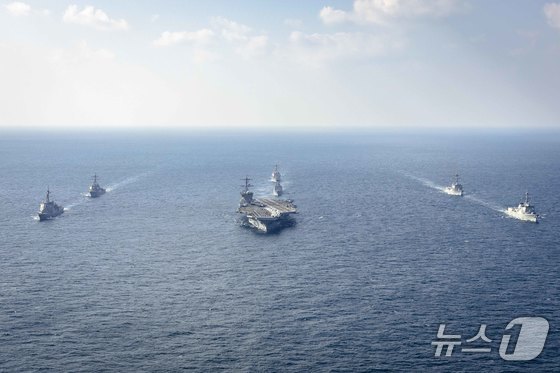
A senior source disclosed on Tuesday that the U.S. Navy’s aircraft carrier, a key strategic asset, will not participate in the 2025 Freedom Edge multi-domain exercise scheduled for Monday to Friday in international waters south of Jeju. This represents a notable reduction in force participation compared to last year’s drills, leading analysts to predict that North Korea may refrain from high-intensity provocations during the exercise period.
Since yesterday, U.S., South Korean, and Japanese forces have been conducting Freedom Edge exercises, which encompass naval missile defense, anti-submarine warfare, air and missile defense, anti-surface warfare, and cyber defense drills, with naval vessels and air assets taking part.
Freedom Edge was first implemented in June 2024 following the trilateral agreement on multi-domain training reached during the 2023 Camp David summit. A second round of exercises took place in November of the same year. The USS Theodore Roosevelt (CVN-71) participated in the inaugural exercise, while the USS George Washington (CVN-73) joined the second iteration. This year marks the first time a U.S. aircraft carrier will not deploy for these exercises.
The current training involves Aegis destroyers, frigates, fighter jets, maritime patrol aircraft, airborne early warning aircraft, aerial refueling tankers, and helicopters from the U.S., South Korea, and Japan. The South Korean military has maintained a low profile regarding the specifics of participating vessels since announcing the Freedom Edge exercises earlier this month.
The primary reason for the absence of a U.S. aircraft carrier in this edition of Freedom Edge, the first since the inauguration of President Donald Trump and President Lee Jae-myung, is reportedly due to U.S. force commitments elsewhere. Military sources indicate that two U.S. carrier strike groups are currently deployed in the Middle East.
Some analysts speculate that the carrier’s absence may reflect President Trump’s stance that deploying strategic assets near the Korean Peninsula comes at a cost. However, defense officials refute this interpretation, asserting that the U.S. and South Korea will maintain a robust combined defense posture to support peace and stability on the Korean Peninsula and in the region.
Nevertheless, there is speculation that North Korea’s strong opposition to U.S.-South Korea military exercises may have influenced this decision. President Trump has shown keen interest in dialogue with Kim Jong Un, the General Secretary of North Korea’s Workers’ Party, while President Lee has emphasized rebuilding inter-Korean trust, pursuing a conciliatory approach aimed at restoring dialogue. This raises the possibility of prior consultation between the U.S. and South Korea regarding the carrier’s participation in the exercises.
On the 14th, North Korea criticized the U.S.-South Korea-Japan exercises through statements from Kim Yo-jong, Deputy Director of the Workers’ Party, and Pak Jong-chon, the top-ranking military officer, warning that their counteractions would be more explicit and intense.
However, the absence of a U.S. aircraft carrier in this training has reduced North Korea’s justification for provocative military actions. Additionally, this year’s Freedom Edge exercise will occur only once, unlike last year’s two iterations.
Prior to the U.S.-South Korea joint exercise Ulchi Freedom Shield (UFS) in August, North Korea also refrained from high-intensity provocations such as nuclear missile launches. While the U.S. and South Korea conducted UFS as a routine exercise, they postponed about 20 out of more than 40 planned field training exercises (FTX) to September.