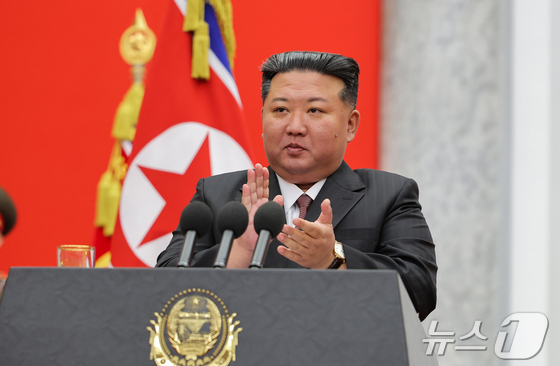
The Lee Jae-myung administration has reaffirmed its three-step approach to North Korea’s denuclearization: suspension (freeze) → reduction → elimination.
While the government avoids using the term disarmament, critics argue that the reduction phase essentially implies nuclear disarmament. This has led to concerns, raised on the 18th, that the government’s plan tacitly acknowledges North Korea’s status as a nuclear power.
National Security Office Director Wi Sung-rak outlined the government’s three-step denuclearization strategy during a meeting with the Korea News Editors’ Association in Seoul on Wednesday. He stated that it must approach this by stopping, reducing, and eliminating the North Korean nuclear development process.
This plan marks a departure from the 2018 denuclearization talks, which aimed for a complete, one-time elimination of North Korea’s nuclear capabilities in exchange for compensation (a big deal). Instead, it resembles a phased approach (small deal), where North Korea would receive incremental rewards for gradually dismantling its nuclear program.
Notably, this strategy aligns with the approach taken by the second Donald Trump administration. President Trump’s repeated references to North Korea as a nuclear power seemed to tacitly recognize its nuclear status. Many interpret the U.S. denuclearization plan as leaning towards a small deal predicated on arms reduction.
However, this approach carries risks. If negotiations break down or fail to achieve lasting agreements, talks could stall while implicitly acknowledging North Korea’s nuclear status. There is concern that Pyongyang might exploit this, securing economic benefits and bolstering its position as a nuclear power before withdrawing from negotiations.
Furthermore, the concept of disarmament itself implies reducing existing nuclear capabilities, potentially legitimizing North Korea’s nuclear status. Critics argue that the government should exercise more caution in its official stance on this matter.
Addressing these concerns, Director Wi clarified that the government does not have a comprehensive roadmap. He stated that even if they create a roadmap, it would be theoretical and not necessarily practical, and the key is to restart the negotiation process. This suggests a priority on bringing North Korea back to the negotiating table.
Given the U.S.’s significant influence over North Korean issues, developing a pragmatic approach is crucial. The Lee government has positioned the U.S. as a peacemaker while asserting South Korea’s role as a pacemaker, advocating for a substantive U.S.-led policy on the North Korean nuclear issue.
However, experts emphasize the need for the government to provide more detailed explanations that can persuade the public while maintaining the stance of not recognizing North Korea as a nuclear state.
A former Ministry of Foreign Affairs official, speaking on condition of anonymity, warned that if compensation is provided at the initial freeze stage rather than the reduction phase, it could entrench North Korea’s nuclear capabilities. Further noting that it must clearly define how it’ll progress through the three stages. The official suggested that the government’s current focus on the three-stage approach might be more about enticing North Korea into dialogue rather than presenting a definitive plan.
Professor Park Won-gon from Ewha Womans University observed that regardless of the feasibility of the three-step denuclearization theory, it’s evident that the government considers denuclearization a core objective. He added that the critical question is whether the freeze means a verifiable halt or just a declarative pause. Further noting that a freeze should involve verification of suspended facilities, while a stop might be merely rhetorical and that this distinction needs clarification.