North Korea has recently attracted attention by publishing research on algorithmic solutions to traffic congestion in an international academic journal.
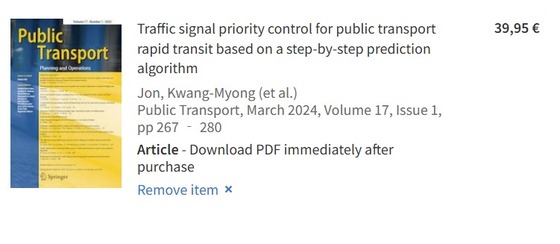
According to the Kim Il Sung University website on Thursday, researchers Jeon Gwang-myung, Han Gwang-bok, Jo Cheon-il, and Kim Cheon-woong from the Advanced Technology Development Institute published a paper in Public Transport, a journal issued by the German academic publisher Springer Verlag.
This journal is released in March, June, and October each year. Their paper, titled, Traffic Signal Priority Control for High-Speed Rail Based on Stepwise Prediction Algorithms, appeared in the March issue.
The researchers noted that, as urban populations have surged globally, traffic congestion in cities has become a critical issue. They added that many countries are now trending toward extensive use of public transportation (PT) to address urban environmental pollution and congestion.
In their study, they proposed a traffic signal priority control method designed to reduce travel time for public transport vehicles, such as trolley buses, based on a ‘stepwise prediction algorithm’ for intersection traffic flow.
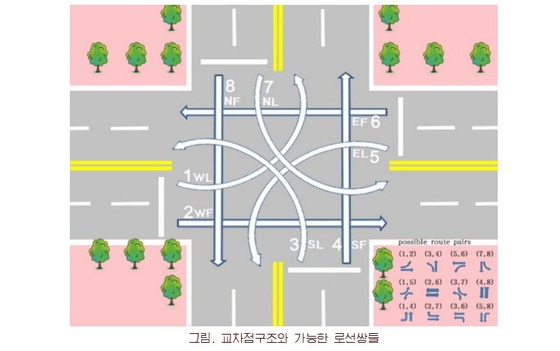
The team first developed a formula to calculate vehicle wait times at four-way intersections. They then determined optimal signal changes to expedite public transport movement. A special weighting factor was applied to public transport vehicles, such as buses, ensuring they receive signal priority over private vehicles.
To validate their algorithm, the researchers employed SUMO, an open-source traffic simulation program. The results demonstrated a significant reduction in public transport waiting times, with average wait times decreasing by approximately 30% compared to the existing longest queue first method.
Access to this paper requires a publisher subscription; for a monthly fee of 37.37 EUR (about 43.84 USD), readers can access ten papers. Individual paper access costs 39.95 EUR (about 43.84 USD) without a subscription.
North Korea’s scientific and technological research personnel are primarily concentrated in the State Academy of Sciences and Kim Il Sung University. Notably, the university’s artificial intelligence (AI) research is striving to establish new AI-related departments, indicating the North Korean government’s focus on advancing information technology (IT).
However, United Nations (UN) Security Council resolutions on North Korea sanctions include restrictions on financial transactions and technology transfers with North Korea. This could potentially classify collaborations with North Korean authors or financial dealings as sanctions violations. Some international academic publishers, such as Elsevier, generally restrict paper submissions from authors with North Korean nationality and explicitly state that they cannot provide peer review and editorial services to authors residing in North Korea.