

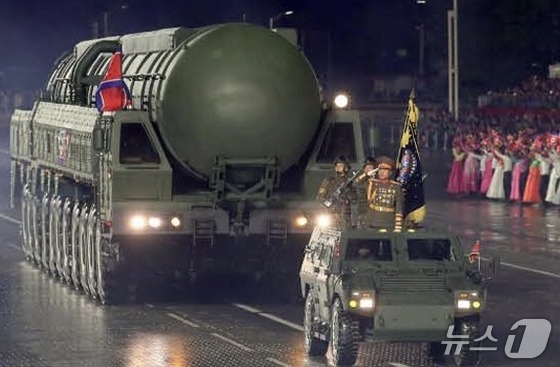
North Korea unveiled its new intercontinental ballistic missile (ICBM), the Hwasong-20, during the 80th anniversary celebration of the Workers’ Party, touting it as its most powerful nuclear strategic weapon system. This long-range nuclear missile, with an estimated range of about 15,000 km (about 9,320 miles), is designed to strike the U.S. mainland.
The party’s official newspaper, Rodong Sinmun, reported on October 11 that a grand military parade commemorating the party’s 80th anniversary was held the previous day in Kim Il Sung Square.
According to the newspaper, spectators erupted in enthusiastic cheers as the Hwasong-20 formation—representing the Democratic People’s Republic of Korea’s most formidable nuclear strategic weapon system—entered the square. The publication also released several images of the Hwasong-20 housed in its launch canister.
Kim Jong Un, General Secretary of the Workers’ Party, announced last month the successful development of a new solid-fuel engine for the Hwasong-20. Solid fuel, which operates similarly to a battery, offers significant advantages over liquid fuel, including shorter launch preparation times and the ability to be stored for extended periods without risking damage to internal components.
These characteristics make solid-fuel missiles more mobile and easier to conceal and protect, thereby broadening their range of operational capabilities compared to their liquid-fueled counterparts.
The newspaper also reported the parade debut of the Cheonma-20, a new main battle tank boasting formidable offensive capabilities and a robust defense system. Additionally, a new 155mm (about 6.1 inches) self-propelled howitzer was identified among the weapon systems on display.
Other new weaponry showcased included a 600mm (about 24 inches) multiple rocket launcher system, nuclear-capable missiles aimed at South Korea, hypersonic glide vehicles, and hypersonic medium-range ballistic missiles (MRBMs). The parade also featured the Hwasong-11 hypersonic short-range ballistic missile (SRBM), which was first revealed at a weapons exhibition earlier this month.
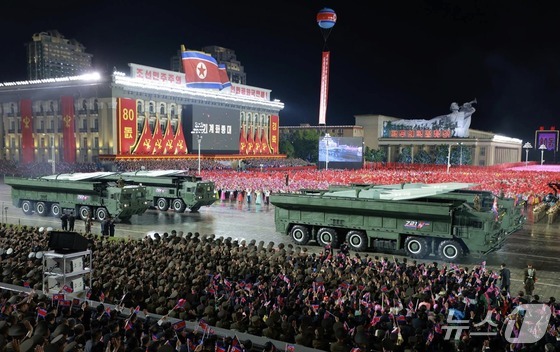
Prior to the parade, Defense Minister No Kwang-chol reported to Pak Jong-chon, Deputy Chairman of the Central Military Commission, that the parade units were in formation. The march then commenced, led by Minister No.
The procession included units responsible for Pyongyang’s defense, coastal and rear area security, and border patrol forces. These were followed by formations from tank armored divisions, mechanized infantry units, reconnaissance and intelligence detachments, sniper teams, communications specialists, and other specialized troops.
The newspaper emphasized that demonstrating the nation’s immense defense technological potential and rapid development, formations of long-range strategic cruise missiles, drone launch vehicles, and ground-to-air and ground-to-ground missile systems marched in succession, showcasing the military might.
A notable addition to the parade was a formation led by a flag bearing the Russian emblem, likely representing a special forces unit that was deployed to Russia last year. This marked the first known instance of overseas-deployed troops participating in a North Korean military parade.
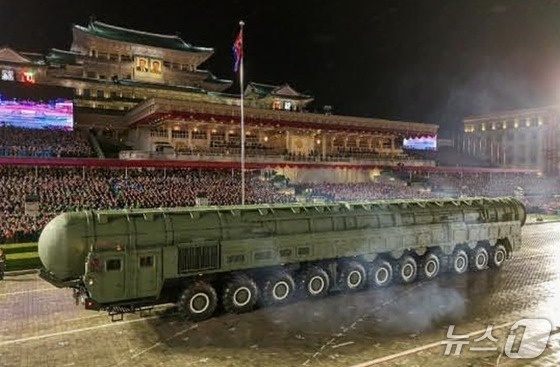
The newspaper further declared that the strategic weapon systems that embody the essence of our self-defense capabilities—continuously strengthened by our party to safeguard our inalienable rights to survival, development, and peace—entered the square with earth-shaking resolve, reiterating the strength of North Korea’s military arsenal.
North Korea used this parade to underscore its status as a nuclear power, displaying various nuclear-capable strategic weapons before high-ranking officials from China, Russia, and Vietnam. While Kim refrained from directly threatening the U.S. and South Korea, the showcase of strategic weapons capable of striking the U.S. mainland served as a clear demonstration of North Korea’s nuclear capabilities.
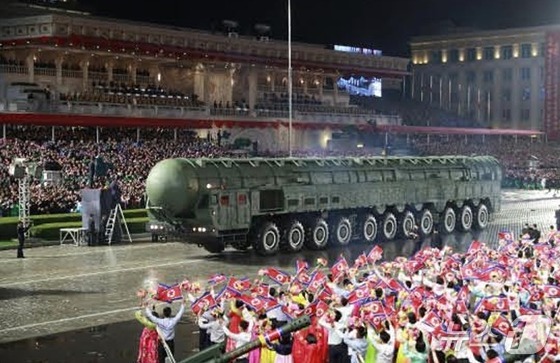
The very important person (VIP) section included Li Qiang, the Chinese Premier visiting North Korea; Dmitry Medvedev, Deputy Chairman of the Russian Security Council; and Le Hoang Minh, General Secretary of the Communist Party of Vietnam. They were joined by members of the Politburo Standing Committee, senior party and government officials, key military commanders, leaders of overseas congratulatory delegations, and veteran officials who have served in significant national roles.