

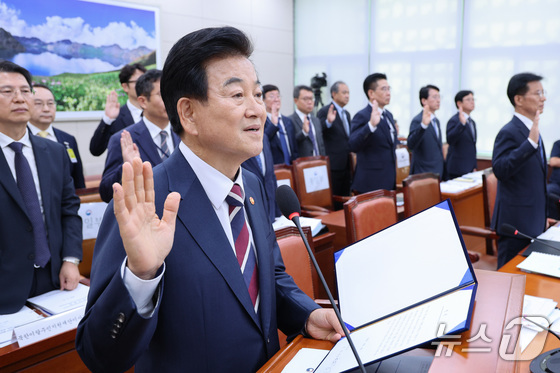
On Tuesday, Minister of Unification Chung Dong-young asserted that North Korea began defining inter-Korean relations as two separate states in 2017, coinciding with its declaration of having completed its national nuclear force.
During a National Assembly audit of the Foreign Affairs and Unification Committee, Minister Chung responded to Democratic Party lawmaker Hong Gi-won’s inquiry about the background of North Korea’s two-state claim. He emphasized the need to examine the history and origins of both adversarial and peaceful two-state theories, referencing North Korea’s amendment to its party charter at the 8th Congress of the Workers’ Party on January 6, 2021.
Minister Chung stressed that in North Korea the party charter is considered more significant than the constitution. He explained that the original purpose of the Workers’ Party of Korea was to build a prosperous socialist state and to promote the liberation of South Korea. It included objectives for national liberation and a nationwide democratic revolution, but these were removed in 2021.
It had previously been reported that the phrase performing the tasks of national liberation and a nationwide democratic revolution, which had been presented as the immediate goal of the Workers’ Party of Korea in the preamble of the amended party charter, was deleted. Minister Chung contends that this marked the beginning of North Korea’s formulation of the two-state theory regarding North and South Korea.
He further noted that prior to this, on November 29, 2017, North Korea successfully launched the intercontinental ballistic missile (ICBM) Hwasong-15 and declared the completion of its national nuclear force, while simultaneously promoting the state-first principle. Chung asserted that the failure of subsequent denuclearization negotiations, along with the realization that unification by a communist takeover was impossible, led North Korea to abandon its stance on the liberation of South Korea—a shift that he described as the root of its transition to a two-state perspective.
Regarding North Korea’s use of the term hostile, Minister Chung stated that President Yoon Suk Yeol’s administration’s antagonistic policy toward North Korea has had a decisive impact. He added that during the Moon Jae-in administration, the relationship was not characterized as hostile two states.
On that day, Minister Chung asserted that inter-Korean relations essentially exist as two separate states, stating that this is a theory of two states within a special relationship, which aligns precisely with the government’s officially maintained national community unification plan.