

Minister of Unification Chung Dong-young stated that President Lee Jae Myung likely does not view North Korea as the primary adversary. He also referenced the government’s agenda item on institutionalizing peaceful coexistence, arguing that the so-called two-state theory does not contradict the Constitution.
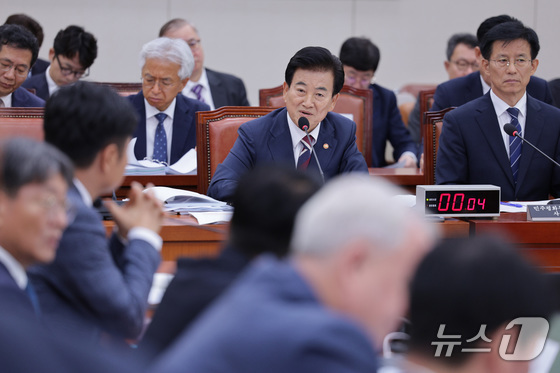
During the National Assembly’s Foreign Affairs and Unification Committee audit on the afternoon of Tuesday, Minister Chung responded to a question from Rep. Kim Seok-ki of the People Power Party. When asked if President Lee considers North Korea the main enemy, he replied that he doesn’t believe it is the main enemy. He added that the President’s perspective is clearly reflected in the government’s agenda, which emphasizes institutionalizing peaceful coexistence.
He explained that due to the dual nature of inter-Korean relations, they have a unique relationship that does not regard us as one nation, as enshrined in the Constitution and determined by the Constitutional Court. At the same time, they have established the Basic Agreement on Inter-Korean Relations and are advancing a community-based unification plan.
Responding to Rep. Kim Gun’s assertion that the Ministers of Defense and Justice, along with the National Security Director, do not endorse the two-state theory, Minister Chung stated that their stance is no different. He added that discussions with the Foreign Minister and the National Security Director are ongoing.
Minister Chung also suggested that a North Korea–U.S. summit might occur in conjunction with the Asia-Pacific Economic Cooperation (APEC) summit scheduled for the end of this month in Gyeongju.
During a morning inquiry, he told Rep. Yoon Hoo-deok of the Democratic Party that based on the analysis of publicly available information and data, both the North Korean and U.S. leaders appear prepared. The key now lies with President Donald Trump’s decision.
Regarding Kim Jong Un’s recent speech at the Supreme People’s Assembly, Minister Chung remarked that the essence is that he harbors positive memories of President Trump and is open to meeting if the dialogue centers on peaceful coexistence. He predicted that if a North Korea–U.S. summit takes place, Panmunjom would be the most likely location.
Minister Chung further analyzed that North Korea’s recent display of nuclear capabilities during the 80th-anniversary parade of the Workers’ Party, strongly backed by China and Russia, suggests the potential for resuming the North Korea–U.S. summit.
He also referenced the precedent of resuming inter-Korean and North Korea–U.S. dialogue in 2018 following the declaration of ‘completing national nuclear power’ in 2017, noting that there’s a sense of déjà vu here.