

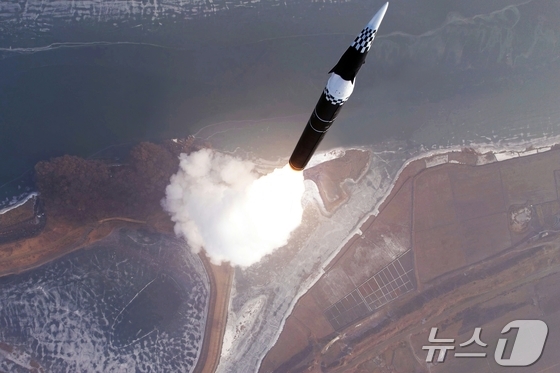
North Korea has resumed its ballistic missile launches after a five-month hiatus, just days before the Asia-Pacific Economic Cooperation (APEC) summit scheduled for next week in Gyeongju. This marks the first ballistic missile test since President Lee Jae Myung took office.
The Joint Chiefs of Staff reported on Wednesday that South Korean forces detected multiple short-range ballistic missiles (SRBMs) launched northeastward from the Chungwha area in North Korea’s North Hwanghae Province at approximately 8:10 a.m. (South Korean time).
The detected North Korean missiles traveled about 350 km (about 217 miles). U.S. and South Korean officials are currently conducting a detailed analysis of the missile specifications and types.
According to the Joint Chiefs of Staff, South Korean and U.S. intelligence agencies had been monitoring North Korea’s missile launch preparations and immediately detected and tracked the launch. They added that relevant information was promptly shared with their U.S. and Japanese counterparts.
This ballistic missile launch is North Korea’s first since May 8, when it test-fired 600mm (about 24 inches) multiple rocket launchers and the Hwasong-11 tactical ballistic missile into the East Sea.
South Korean military sources believe the missiles detected today are likely the new Hwasong-11a-4.5 tactical ballistic missiles, which North Korea first launched on September 18 last year.
The Hwasong-11a-4.5 is an upgraded version of the KN-23, often dubbed the North Korean Iskander, with an enhanced 4.5-ton (about 9,000 pounds) warhead. It is believed to possess sufficient destructive power to neutralize key South Korean facilities, including underground bunkers. Given its range, this weapon is clearly designed for use against South Korea, making today’s test launch a clear show of force directed at Seoul.
South Korean military officials are closely monitoring the possibility of further weapons tests by North Korea in the near future. During the October 10 military parade celebrating the 80th anniversary of the Workers’ Party, North Korea showcased new short-range ballistic missiles, including the Hwasong-11m equipped with a hypersonic glide vehicle (HGV)-style warhead, a new Hwasong-20 intercontinental ballistic missile (ICBM) targeting the U.S. mainland, and hypersonic medium-range strategic missiles.
The Joint Chiefs of Staff emphasized that under the robust U.S.-South Korea combined defense posture, their forces remain vigilant to various North Korean activities and maintain the capability and readiness to respond decisively to any provocation.
North Korea’s latest ballistic missile launch is particularly significant as it is the first since President Lee took office in June. The timing—just before U.S. President Donald Trump and Chinese President Xi Jinping are set to visit South Korea for the APEC summit—is widely interpreted as a deliberate show of military strength.
Some analysts suggest that North Korea is using this missile launch to signal its disinterest in dialogue with the U.S. While there has been no official statement from Washington, diplomatic sources speculate that President Trump may seek a meeting with Kim Jong Un during his visit.
Additionally, this missile test is the first provocation following the recent inauguration of Japan’s new Prime Minister, Sanae Takaichi. Known for her hawkish stance, Takaichi is expected to pursue a tougher line on North Korea, including intensified efforts to address the issue of Japanese citizens abducted by North Korean agents.