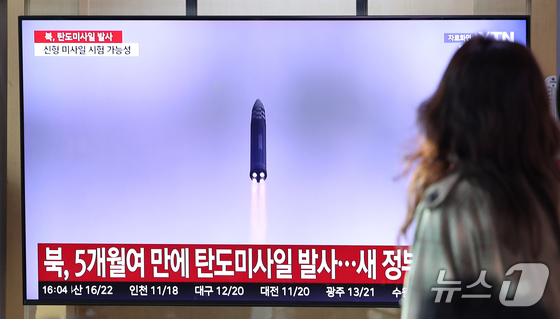
On Thursday, North Korea released limited information about the ballistic missile it launched the previous day. While announcing the launch to the international community, the regime appeared to withhold details from its own citizens. Notably, Kim Jong Un did not attend the launch. This approach suggests that Pyongyang is employing a low-key reporting strategy to manage its narrative.
The Korean Central News Agency reported on Thursday that the Missile Bureau had successfully conducted tests of critical weapon systems on Wednesday. The agency stated that two hypersonic vehicles, launched northeast from Pyongyang’s Ryongpo district, hit targets on the Gwaesangbong plateau in North Hamgyong Province.
While the agency mentioned testing important weapon systems, it refrained from naming or providing specifics about the weapons. Based on released photos, analysts believe the test involved the Hwasong-11M variant, a North Korean Iskander-type missile equipped with a hypersonic glide vehicle (HGV). The Hwasong-11M, presumably developed for use against South Korea, was recently showcased at the Defense Development-2025 weapons exhibition and the parade marking the 80th anniversary of the Workers’ Party.
Significantly, North Korea did not publish this report in the Rodong Sinmun, a newspaper accessible to its citizens. Korean Central Television also appears to have omitted coverage of the launch. Given North Korea’s restricted internet access, reports exclusive to the Korean Central News Agency are unlikely to reach the general population.
Experts suggest two reasons for North Korea’s cautious approach. First, the new weapon may still be in the testing phase and not yet fully operational. Missile development requires extensive testing, and since U.S. and South Korean surveillance typically detects North Korean missile activities, Pyongyang may have opted for limited reporting rather than full concealment.
Historically, North Korea would stage events in which Kim personally oversaw the operational debut of new weapon systems once they were completed, using all media outlets to extensively promote their capabilities and significance. Therefore, additional launches of the Hwasong-11M with Kim in attendance may occur later this year, followed by widespread propaganda celebrating these achievements.
Some analysts interpret this behavior as an attempt to calibrate tensions while drawing a line ahead of the upcoming Asia-Pacific Economic Cooperation (APEC) summit.
Following the missile launch, experts suggested that North Korea aimed to preempt any possibility of an emergency meeting with the U.S. in the context of APEC. Moreover, by refraining from launching an intercontinental ballistic missile (ICBM) capable of striking the U.S. mainland, Pyongyang seems to be avoiding unnecessary provocation. The Korean Central News Agency claimed that the missile launch was intended to strengthen self-defense capabilities.
Kim’s attendance at nuclear-related events can foster hostile perceptions among citizens towards external powers. By limiting the report to external media, North Korea appears to be avoiding an internal escalation of tensions with the U.S. and South Korea.
Hong Min, a senior researcher at the Korea Institute for National Unification, stated that if North Korea intended to directly provoke the U.S., Kim would have overseen an ICBM or medium-range missile launch targeting the U.S. mainland or U.S. forces in Japan. While there’s clearly an intent to apply measured pressure on the U.S., Pyongyang is evidently trying to avoid unnecessary provocation.
This ballistic missile launch marks the first since the inauguration of the Lee Jae Myung administration. North Korea’s previous ballistic missile launch occurred on May 8, when it fired various short-range ballistic missiles, including the Hwasong-11.