

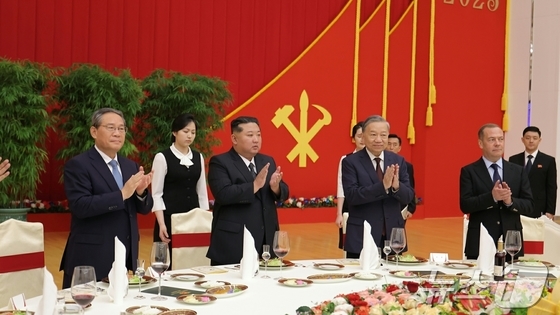
The participation of Vietnam, Indonesia, and Laos in North Korea’s Workers’ Party 80th anniversary celebrations reflects their hedging strategy, which aims to balance relations between the United States and China while building cooperative networks, according to an analysis released Friday.
Lee Jae Hyun, a senior researcher at the Asan Institute for Policy Studies, argued in a report titled “The Significance of Southeast Asian Countries’ Participation in North Korea’s Workers’ Party Foundation” that these three Southeast Asian nations dispatched large, high-level delegations to North Korea’s party founding event as part of their diversification strategy, marking a departure from previous years.
Lee explained that Southeast Asian countries are currently pursuing strategic diversification to alleviate pressures from the United States, including tariffs. He noted that the close engagement that some Southeast Asian nations maintain with North Korea is an integral component of this diversification strategy.
Vietnam’s top leader, Communist Party General Secretary Nguyen Phu Trong, attended the Workers’ Party’s founding event. Laotian President Thongloun Sisoulith visited North Korea just before the party’s anniversary, holding a summit with Kim Jong Un, the Workers’ Party’s general secretary. Indonesia also sent its foreign minister for the first time in 12 years.
Lee suggested that Nguyen’s visit to North Korea served as a reciprocal gesture following Kim Jong Un’s 2019 trip to Vietnam for the North Korea-U.S. summit. He speculated that this move might be laying the groundwork for Vietnam to host another North Korea-U.S. summit in the future.
While Indonesia sent its foreign minister in place of its head of state, the country has shown the greatest interest in Korean Peninsula affairs among Southeast Asian nations. This indicates Indonesia’s intention to maintain neutrality between North and South Korea while serving as a bridge for peace on the peninsula.
Moreover, as the power struggle between the United States and China intensifies, this diplomatic outreach to North Korea reflects a broader strategy to maintain neutrality and foster cooperative relationships with both global powers.
Lee emphasized that as U.S. foreign policy strategically underestimates Southeast Asia and imposes economic pressures through tariffs, these countries may adopt a strategy of strong solidarity either individually or collectively through ASEAN, firmly aligning themselves with either ‘China’s camp’ or the opposing ‘U.S. camp.’
He noted that this strategy has manifested in Southeast Asian countries’ diversification efforts since last year, including cooperation with BRICS and attempts to join the Shanghai Cooperation Organization (SCO). This year, it has extended to participation in China’s Victory Day celebrations and, more recently, to taking part in North Korea’s Workers’ Party founding anniversary events.
However, Lee cautioned that the current actions of these Southeast Asian nations do not necessarily signal full alignment with China or other powers opposed to the United States. He added that the diplomatic strategies of communist Southeast Asian countries remain fluid and can change rapidly in response to developments in U.S.-China relations.