

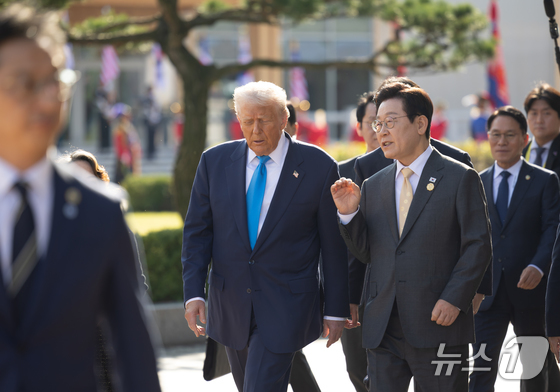
On Wednesday, President Lee Jae Myung requested fuel supply for nuclear-powered submarines during a summit with President Donald Trump, mentioning submarines from China and North Korea. National Security Advisor Wi Sung-lac clarified that the President’s remarks were not targeting specific countries’ submarine activities but emphasizing the need for enhanced submarine detection capabilities in regional waters.
During a press briefing at the Asia-Pacific Economic Cooperation (APEC) International Media Center in Gyeongju, Advisor Wi stated that it needs to be able to detect any submarine operating in the vicinity.
He explained that he believes the President was stressing this point, given that submarines are inherently stealthy and challenging to detect.
Earlier in the summit, President Lee urged President Trump to make a decision to allow them access to fuel for nuclear-powered submarines.
President Lee elaborated that they’re not seeking to build nuclear-armed submarines. Its diesel submarines have limited submerged endurance, which constrains the ability to track North Korean or Chinese submarines. If permitted to acquire nuclear propulsion technology, it could construct several conventionally-armed submarines. This would enhance its defensive capabilities in the East and West Seas, significantly reducing the burden on U.S. forces in the region.
The summit also saw both nations reach a consensus on key security issues. In his opening remarks, President Lee pledged to increase defense spending and requested a revision of the nuclear agreement to facilitate the acquisition of nuclear-powered attack submarines.
President Trump responded positively, praising South Korea’s proactive role as an ally. He acknowledged South Korea’s need for nuclear submarine capabilities, given the changing strategic landscape, including North Korea’s pursuit of nuclear submarines. Trump suggested continuing discussions on this matter.
Advisor Wi revealed that President Lee also raised concerns about South Korea’s reliance on Russian nuclear fuel imports and the pressing issue of nuclear waste disposal. Lee stressed the necessity of developing uranium enrichment and nuclear fuel reprocessing capabilities. President Trump concurred, stating that both nations should explore greater cooperation in critical strategic domains, including nuclear energy, leveraging South Korea’s advanced technological capabilities.