

An analysis of North Korean leader Kim Jong Un’s public activities in October, amid the Asia-Pacific Economic Cooperation (APEC) summit in Gyeongju, revealed his focus on strengthening ties with Russia and China.
The Ministry of Unification reported that six out of Kim’s 19 public engagements in October emphasized close cooperation with these two nations.
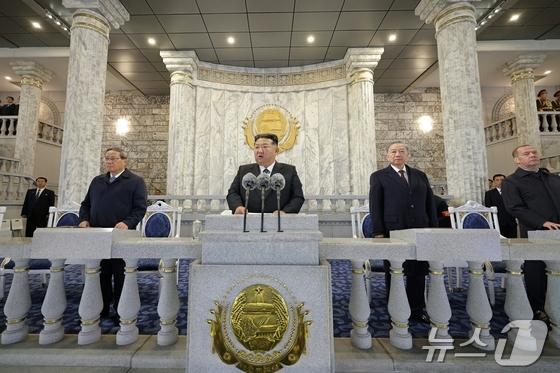
On October 9, the eve of the Workers’ Party’s 80th anniversary, Kim met with Li Qiang, China’s second-ranking official, to discuss expanding strategic communication between their countries. That same day, he attended a celebratory performance by a Russian artistic delegation at Pyongyang’s Mansudae Art Theatre.
On the anniversary itself, Kim participated in a military parade at Kim Il Sung Square. The podium arrangement was telling: Li stood to Kim’s right, while Vietnam’s top leader, General Secretary Nguyen Phu Trong, and Russia’s Dmitry Medvedev, Deputy Chairman of the Security Council, flanked his left.
This scene mirrored September’s 80th anniversary parade in China, where President Xi Jinping, Kim, and Russian President Vladimir Putin stood together, reinforcing the North Korea-China-Russia trilateral alignment.
Later that day, Kim met separately with Medvedev, expressing his desire to elevate North Korea-Russia relations to a comprehensive alliance.
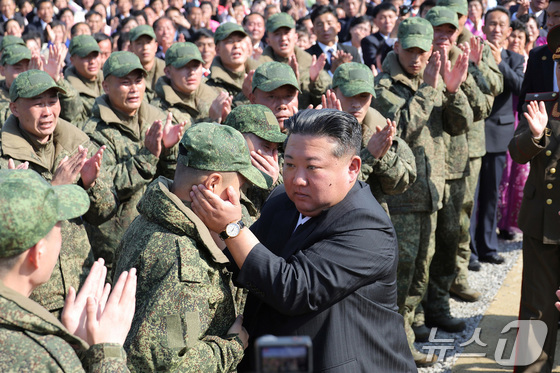
On October 23, Kim attended the groundbreaking ceremony for the Overseas Military Operations Combat Merit Memorial in Pyongyang, honoring North Korean troops deployed to Russia. He declared Pyongyang’s unwavering support for Moscow, showcasing the North Korea-Russia military alliance.
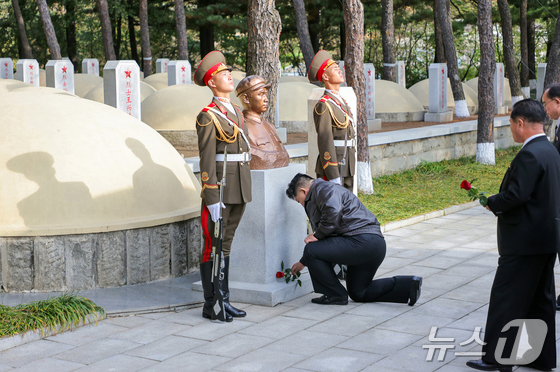
The following day, Kim paid respects at the Chinese People’s Volunteers Martyrs’ Cemetery. He honored Chinese troops who fought in the Korean War, notably laying flowers at the grave of Mao Anying, son of former Chairman Mao Zedong, who died in U.S. airstrikes during the conflict.
Kim emphasized that the blood-forged friendship between North Korea and China would continue to demonstrate its resilience in the struggle against imperialism and for socialist ideals, highlighting the strengthening ties based on an anti-U.S. coalition.
Additionally, Kim actively engaged in diplomatic exchanges with socialist allies, including a meeting with Laotian President Thongloun Sisoulith on October 8.
While not a direct activity of Kim, Foreign Minister Choe Son-hui’s visit to Russia and Belarus during the APEC summit further illustrates North Korea’s current diplomatic stance. Some analysts speculate that Choe may have discussed Kim’s potential visit to Moscow while in Russia.
Given this context, experts anticipate Kim will prioritize internal matters in the coming months, such as preparing for the Workers’ Party plenary meeting in December and the expected 9th Party Congress in January. After reaffirming solidarity with allies like Russia and China, he may then approach negotiations with the U.S.
Oh Kyung-seop, a senior researcher at the Unification Research Institute, noted that North Korea must complete its five-year defense and economic development plans by year-end. Kim will likely focus on maximizing achievements in these areas over the next two months.
Lim Eum-chul, a professor at Kyungnam University’s Institute for East Asian Studies, predicted that after successfully concluding the crucial internal political event of the 9th Party Congress, Kim is expected to re-engage in diplomacy.
Lim added that once the Ukraine war concludes, there’s a possibility that the leaders of Russia and North Korea will jointly declare Russia’s ultimate victory and discuss compensation or follow-up measures related to troop deployments.