

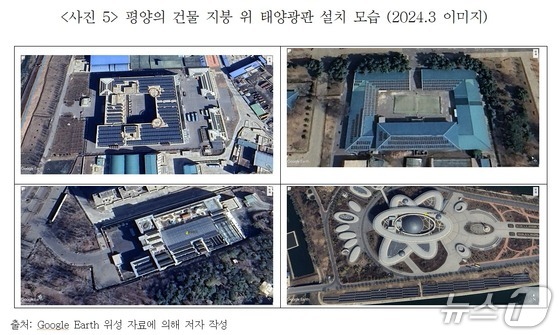
A report released on Tuesday reveals a significant transformation in North Korea’s energy industry structure, with solar power installations rapidly expanding at the factory and enterprise level.
In a report titled, Pyongyang! Surviving with Rooftop Solar Power, researcher Jung Eun-i from the Korea Institute for National Unification assesses that North Korea is bolstering its self-generation capabilities and advancing its energy independence strategy.
The report indicates that over the past 15 years, solar panels have quickly spread to production sites and local administrative offices across North Korea. This trend has become even more pronounced in the aftermath of the COVID-19 pandemic. The shift from primarily residential installations to the emergence of solar facilities at factories and enterprises suggests the establishment of a local and industrial power support system.
Based on interviews with residents in the North Korea-China border regions, Jung explains that solar panels are being imported through China, both officially and unofficially.
However, external trade statistics do not clearly reflect this change. The report notes that North Korea’s solar panel imports from China have actually decreased recently, highlighting the limitations of using trade data to gauge the speed or scale of internal distribution.
The report predicts that while North Korea’s heavy industry continues to grapple with chronic power shortages, the expansion of solar technology-driven industries will progress simultaneously.
Additionally, the report outlines policy directions in anticipation of future changes in inter-Korean relations. It suggests that if inter-Korean dialogue resumes, North Korean authorities may approach negotiations with a significantly different calculus than before. The report emphasizes that future inter-Korean cooperation should evolve beyond simple production cooperation models like the Kaesong Industrial Complex, towards a more advanced paradigm centered on technology, efficiency, environmental sustainability, and energy independence.
The report recommends that South Korea acknowledge North Korea’s changed economic reality and approach cooperation not as aid-based but as a partnership fostering self-reliance. It suggests a shift from simple manufacturing complexes to decentralized, sustainable industrial platforms, viewing this as a pragmatic solution for shared prosperity on the Korean Peninsula.