

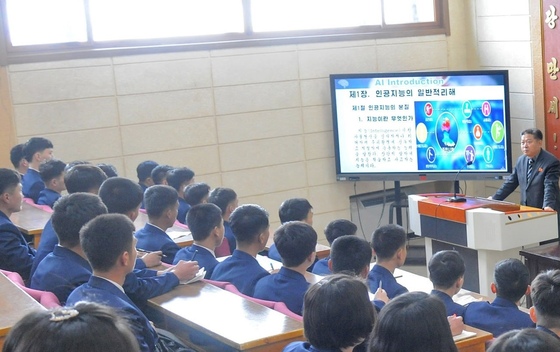
I visited the Korea Computer Center (KCC) in Pyongyang’s Mangyongdae District twice in May 2006. Established in 1990, it was the central hub for the national computer program industry and operated directly under the Cabinet at the time.
In a conference room displaying Kim Jong Il’s quote that the twenty-first century is the era of the information industry, I received an overview of the center’s programs and toured several affiliated development units. The most notable was the Cheongbong Information Center, which specialized in the development of artificial intelligence technology. This research center was tasked with developing and distributing AI programs, a relatively new concept at the time.
At this center, over 150 researchers in their 20s and 30s worked on various sectors, including natural language processing, inference, and search. They were developing programs for Korean character recognition, automatic music search, statistical inference, facial recognition, voice recognition, multilingual automatic translation, and rule-based inference systems.
North Korea began using the term artificial intelligence (AI) around the time of KCC’s establishment. In 2000, Kim Il Sung University and Kim Chaek University of Technology introduced AI courses, marking the beginning of serious AI workforce development.
In 1997, KCC developed the Go program Eunbyeol using rudimentary AI technology. The AI Go program, which evolved to Eunbyeol 2010, consistently won the World Computer Go Championship, earning recognition as one of the best at that time.
Despite being the top software development institution in the country, the center’s AI technology was mainly applied to military programs and foreign contract work. It had a limited impact on the domestic economy and daily life because computers, mobile phones, and digital appliances were not widely used in North Korea.
North Korea did achieve results in multilingual machine translation using AI. Dissatisfied with the automatic translation program from KCC’s Cheongbong Information Center, Kim Jong Il ordered Kim Il Sung University to develop the Youngjo Machine Translation Program in late 2006. He personally attended the 18th National Program Competition and Exhibition in January 2008 to observe the Ryongnamsan translation program. A decade later, in 2017, the university’s AI Technology Research Institute developed Ryongnamsan 5.1, an improved voice recognition program, and Ryongma, a bidirectional translation device supporting seven languages.
In 2013, North Korea established the Artificial Intelligence Research Institute, the first national-level AI research organization under the Cabinet. Around 2019, AI emerged as a core focus in the country’s information and computerization efforts. North Korea publicly committed to promoting AI product development, recognizing it as a key technology in the Fourth Industrial Revolution.
The National Informatization Performance Exhibition – 2019, themed Digital Economy and Informatization Wave, showcased North Korea’s transformed AI capabilities. This exhibition, the largest IT event in North Korea since 2016, highlighted AI, robotics, IoT, facial recognition, e-commerce, and electronic payments. It also introduced new smartphone applications and 3D printing technology applications.
Kim Il Sung University’s Information Technology Research Institute launched ten products, including five AI products such as facial recognition devices, intelligent high-frequency devices, and fire monitoring systems. An institute official outlined four strategic goals: AI, augmented reality, autonomous control, and information security technologies. They’re developing intelligent medical diagnostics, holograms, autonomous robots, self-driving systems, and mobile and IoT security technologies.
Though still basic, cloud computing and big data products were also unveiled. A notable example was the Security Video Surveillance System, which uses deep learning for facial recognition, license plate recognition, and intruder detection, incorporating big data technology.
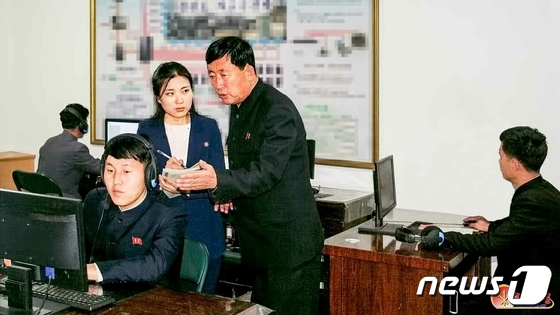
North Korea has invested heavily in AI for the past 4 years and recently began using ChatGPT.
Following the 8th Workers’ Party Congress in 2021, North Korea set the ambitious goal of quickly achieving world-class AI capabilities. They reorganized institutions, expanding the information technology department under the State Affairs Commission and merging key communications agencies to create a new Ministry of Information Industry under the Cabinet.
Recently, they’ve begun using ChatGPT, developed by OpenAI. Kim Il Sung University’s AI Technology Research Institute announced plans to use GPT technology to replace human mental labor. North Korea is also establishing AI departments in universities.
Since the 1990s, North Korea’s AI technology has progressed from basic research at KCC and Kim Il Sung University to attempting a North Korean version of ChatGPT. Like South Korea, they’re focusing on developing sovereign AI while ensuring domestic control over data, technology, infrastructure, talent, laws, and ethical standards.
State and university AI research institutes have proliferated, as have companies producing commercial AI, big data, IoT, and cloud computing products. Top performers include Samhung Economic Information Technology, Apnara Advanced Technology Exchange, Pyongyang Kwangmyong Information Technology, Blue Sky Trading, and Chosun Mangyong Trading.
The National Informatization Performance Exhibition in 2025 showcased significant AI advancements. North Korea claimed rapid progress in information, digital, and AI technologies, elevating national management and social life. The event featured AI program competitions, digital TV and smartphone showcases, and exhibits of intelligent guide robots and educational robots with voice and facial recognition.
AI is now permeating North Korean life through over 6 million mobile phones, computers, and digital TVs. North Korean smartphones integrate AI for voice recognition, translation, and object recognition. The national intranet, Kwangmyong, offers AI-powered services including email, news, search, and e-commerce. The facial image restoration program Seonmyeong 1.0 by Amnok River Technology Development Trading Company received acclaim at a recent North Korea-Russia exhibition.
Concerns are rising about North Korea’s military applications of AI, including war simulations, drone operations, and cyberattacks. However, some analysts suggest that North Korea’s alignment with international AI standards could facilitate future inter-Korean cooperation. Last year’s treaty with Russia on strategic partnership in science, technology, and IT, including AI collaboration, could pave the way for joint North-South AI initiatives.
The AI-driven digital transition is poised to revolutionize lifestyles, including in North Korea. This necessitates comprehensive research on AI’s impact on North Korea’s economy and society, alongside preparations for its military applications.