

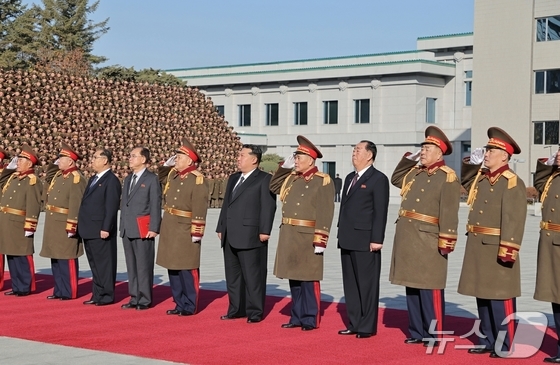
Kim Jong Un, the General Secretary of North Korea’s ruling Workers’ Party, visited the Ministry of State Security, North Korea’s equivalent to the U.S. Central Intelligence Agency. This public visit to an intelligence agency demonstrates his personal involvement in internal control and suggests a lack of interest in dialogue with either the United States or South Korea.
On Wednesday, the party’s official newspaper, Rodong Sinmun,reported that Kim made a congratulatory visit to the Ministry of State Security on Tuesday to commemorate the agency’s 80th anniversary.
The Ministry of State Security is North Korea’s primary agency for regime preservation and discipline, carrying out tasks unique to maintaining the North Korean system. Known for its extensive power, the agency is primarily responsible for uncovering spies and counter-revolutionaries, monitoring citizens’ ideological leanings, and conducting intelligence operations against South Korea.
Previously, in October 2012, the year he assumed power, Kim visited the State Security Department, the predecessor of the current Ministry of State Security, to pay his respects at a statue of Kim Jong Il. He returned to the department again in November of the same year. However, he had not publicly visited the site since then, over 13 years ago.
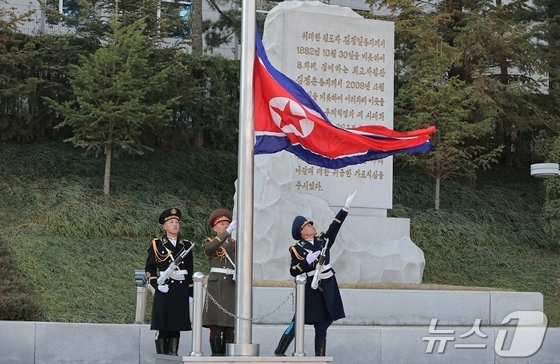
Photographs from Kim’s recent visit show a plaque indicating that Kim Jong Il visited the site eight times, including on October 30, 1982, and that Kim Jong Un himself visited several times, including in April 2009. This suggests that Kim may have made unofficial visits to the location before formally assuming power.
On the same day, Kim also visited the Ministry of Social Security, which handles police work, and the Supreme Court and Supreme Prosecutors’ Office, which oversee judicial matters. Analysts interpret these consecutive visits to key institutions crucial for maintaining and strengthening his power as a deliberate effort to tighten internal control and consolidate the regime.
It is noteworthy that Kim adhered to this schedule even as North Korea has shown little response to South Korea’s proposal for inter-Korean military talks. On Monday, the South Korean Ministry of National Defense officially proposed discussions with North Korea on establishing a military demarcation line (MDL) within the Demilitarized Zone (DMZ), but North Korea has yet to respond.
Furthermore, the day before Kim’s visit, North Korea criticized the U.S.-South Korea summit fact sheet through the Korean Central News Agency, claiming that confrontational intentions had once again been formalized and institutionalized. However, Kim appeared to focus on domestic affairs, seemingly unconcerned with this criticism. Observers suggest this behavior indicates that, as the supreme leader, Kim is prioritizing the consolidation of his power base over external developments.
As the 9th Workers’ Party Congress approaches in mid-December, analysts expect Kim to concentrate on strengthening internal systems and achieving results. This analysis suggests he intends to focus more on domestic rather than foreign affairs in the coming months.
Oh Kyung Seop, a senior researcher at the Korea Institute for National Unification, noted that in the lead-up to the 9th Party Congress, North Korea is visiting institutions that play a crucial role in maintaining the regime and ensuring power stability. They currently show little interest in U.S.-North Korea or inter-Korean dialogue while focusing on internal discipline and cohesion.