

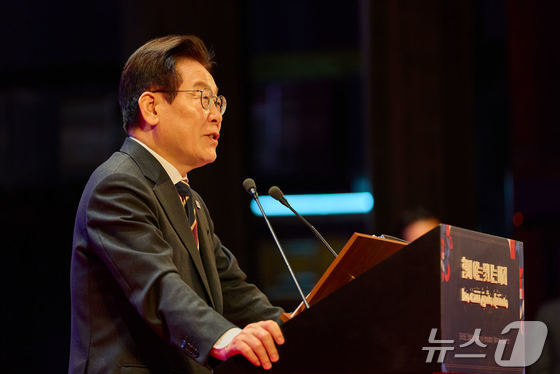
President Lee Jae Myung stated that regarding U.S.-South Korea joint military exercises, it would be preferable to discontinue them if a robust peace regime is established between North and South Korea.
During an in-flight press conference on Air Force One en route to Turkey on Sunday, he addressed the issue, saying that North Korea remains highly sensitive about the joint drills and said some have suggested exploring options such as reducing or postponing them.
Lee explained that in the long term, South Korea should assume full responsibility for its own defense. He said the ideal scenario would be creating a peace framework that removes the need for joint drills, avoiding costly exercises that former U.S. President Donald Trump disliked.
He emphasized that South Korea currently allocates a massive defense budget, 1.45 times larger than North Korea’s GDP, and ranks fifth globally in military strength. Yet, the country still lacks wartime operational control. Some mistakenly believe South Korea cannot defend itself without external support and argue that such perceptions should be corrected.
However, Lee acknowledged that it is premature to discuss suspending exercises now and said any changes would depend on evolving political and security conditions.
Lee again stressed the need to improve inter-Korean relations and said efforts must continue even if only a small opportunity for dialogue exists.
He noted that regrettably, inter-Korean relations have become extremely hostile and confrontational. North Korea has erected triple-layered barbed wire fencing along the military demarcation line.
He pointed out that for decades after the Korean War armistice, such actions had been unheard of. He added that during the previous Yoon Suk Yeol administration, North Korea destroyed all railways leading to the South, dismantled roads, and constructed barriers.
He further warned that the situation has reached a point where accidental clashes could occur at any moment. According to him, all lines of communication have been severed, and North Korea continues to reject any form of dialogue, making the situation extremely dangerous. He expressed concern that if an accidental clash occurs, there would be no available means to resolve it, noting that even among hostile nations, emergency hotlines typically exist. Still, in this case, everything has been completely cut off, which he described as deeply troubling.
President Lee emphasized that dialogue must continue and that goodwill should be conveyed consistently. He said that if there are doubts, it is better to communicate twice rather than once, and argued that efforts to pursue dialogue should persist even if it requires actively seeking opportunities.
He also cautioned that abandoning dialogue and pursuing a hardline policy would only worsen the situation. In his view, patience is necessary while simultaneously securing sufficient defense capabilities and deterrence to counter provocations. At the same time, he said channels for communication, dialogue, and persuasion must remain open.
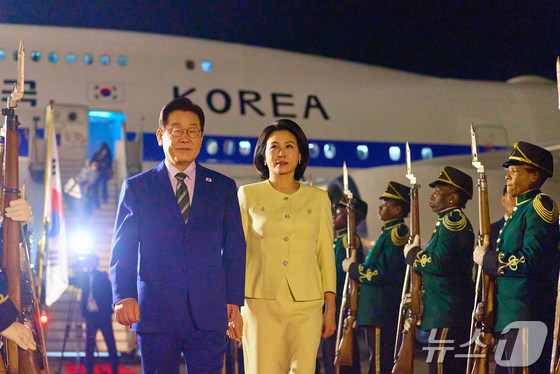
Regarding relations with the United States and China, President Lee said he believes the two relationships are not mutually exclusive. He warned that approaching international relations with an all-or-nothing mentality would ultimately leave South Korea with nothing.
He explained that the cornerstone of South Korea’s foreign policy is the U.S.-ROK alliance, while also maintaining stable relations with China. He said the core principle of diplomacy is to prioritize national interests, with a particular focus on expanding South Korea’s autonomy in military and security affairs. In this context, he referenced the restoration of wartime operational control and the development of nuclear-powered submarines as examples.
He added that from the U.S. perspective, cooperating with China while maintaining appropriate deterrence is a pragmatic approach and part of how international relations function. He also noted that Japan is currently facing major public controversy over statements made by its prime minister. He said South Korea must closely monitor the situation to safeguard and maximize national interests.
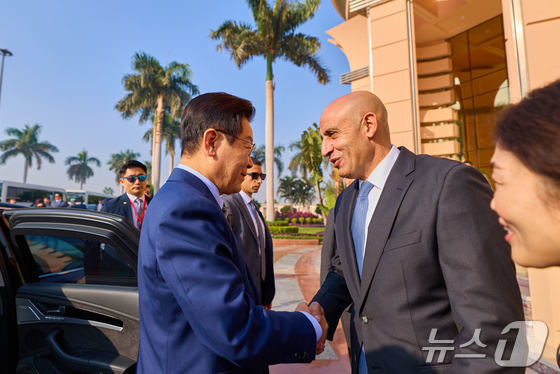
President Lee stressed that exporting defense equipment is a crucial means of establishing diplomatic relations and that it should not be viewed as the sale of ordinary commercial goods.
He observed that demand for defense industry products is increasing faster than expected and noted widespread anxiety in the Middle East over sudden changes. He assessed that collaboration in the defense industry, including joint technology development and production, naturally leads to military and security cooperation.
He added that increased defense investment is unavoidable and argued that the defense industry has become an extremely effective tool for expanding diplomatic relationships.
He said other countries are not simply interested in buying South Korean weapons, but are seeking joint development, production, sales, and market expansion. He mentioned that India has specifically requested collaboration in shipbuilding, likely including defense logistics.
He concluded that defense cooperation is crucial on multiple fronts and said tangible export results are necessary. He expressed confidence that significant outcomes will materialize soon.
Earlier, Indian Prime Minister Narendra Modi proposed a shipbuilding cooperation framework involving South Korea, Japan, and India during his meeting with President Lee. In response, Lee said the proposal still requires evaluation and that it will be discussed further at a later date.