

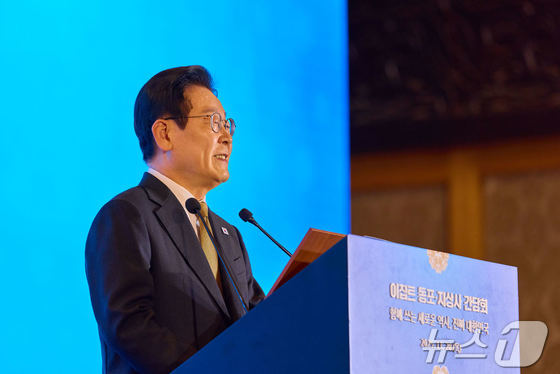
President Lee Jae-myung reaffirmed on Sunday that his administration will pursue improved inter-Korean relations through dialogue, saying even a small opening requires consistent effort.
President Lee made these remarks during an in-flight press conference aboard Air Force One, en route from South Africa to Turkey following the G20 summit.
He assessed the current state of inter-Korean relations, noting they have regrettably become highly antagonistic and confrontational, with a complete lack of even basic trust leading to extreme rhetoric and actions from both sides.
He pointed out that North Korea has erected triple barbed-wire fences along the military demarcation line, an unprecedented move since the armistice of the Korean War. President Lee added that during the previous Yoon Suk Yeol administration, North Korea destroyed railways and roads leading to the South and built barriers.
The president expressed concern about the heightened risk of accidental clashes and said that all communication channels have been cut off, and North Korea refuses any form of dialogue or contact. He warned that without emergency lines, managing or de-escalating a crisis would be nearly impossible.
President Lee criticized the politicization of unification, security, and national interest issues, arguing that such actions have been detrimental to South Korea’s interests. He described these developments as both incomprehensible and unacceptable.
He stressed the importance of sustained efforts to engage in dialogue, convey goodwill, and maintain open lines of communication, even in the face of repeated rejections.
He outlined a phased approach to addressing the nuclear issue, proposing a short-term freeze on nuclear activities, a medium-term reduction, and long-term denuclearization. He also expressed support for North Korea normalizing relations with other countries and encouraged negotiations to halt nuclear and missile activities, even if initially between North Korea and the United States.
The president questioned the wisdom of discussing absorption-style unification, highlighting the potential conflicts and enormous costs associated with such an approach. He criticized politicians for unnecessarily escalating tensions with irresponsible rhetoric.
He attributed the current tensions partly to provocative language about unification, which he believes has led to North Korea’s defensive actions. He described this situation as a form of national karma.
The president suggested that overcoming this negative legacy would require even greater effort and time than what created it.
He concluded by saying that repairing the damage will require patience and more time than what created it, and that improving inter-Korean relations will require both strong deterrence and steady diplomatic effort.