Two North Korean soldiers captured by Ukrainian forces expressed their desire to defect to South Korea last month. However, as of Wednesday, there has been little progress in their actual repatriation process.
With the individuals declaring their intention to defect, discussions should be underway to categorize them as either prisoners of war or defectors under international law. However, negotiations with the Ukrainian government appear to be at a standstill. Experts argue that the U.S. government needs to accelerate negotiations, especially given the ongoing intense discussions regarding a ceasefire in the Ukraine conflict.
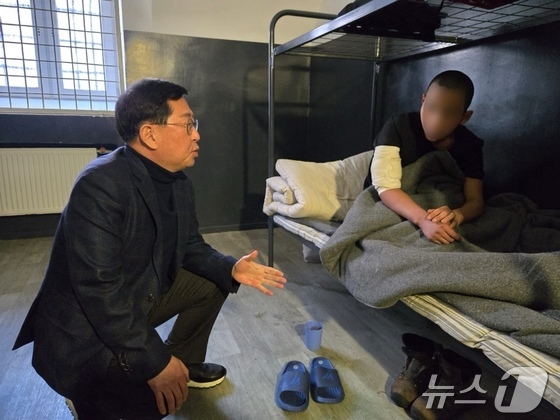
On October 31, documentary filmmaker Kim Young Mi personally interviewed North Korean prisoners Baek and Ri at a POW camp near Kyiv, Ukraine. Kim reported through the North Korea-focused media outlet NK News that both prisoners expressed a strong desire to defect to South Korea, and strongly appealed to be taken to South Korea.
These soldiers were deployed to Russia last year and participated in the Battle of Kursk, one of the fiercest conflicts along the Ukraine-Russia border. Ukrainian forces captured them in January 2023. Ukrainian authorities subsequently released their personal information and interrogation videos on X (formerly Twitter), bringing their existence to international attention.
During a March visit to Ukraine, Rep. Yoo Yong Won of the ruling People Power Party met with the prisoners. At that time, only one expressed a desire to defect, while the other was undecided. Both have now confirmed their intention to come to South Korea.
The U.S. government maintains that these individuals are clearly citizens of South Korea under the constitution and will accept them once their intention to defect is confirmed. However, experts disagree on their legal status, which could become a point of contention in negotiations with Ukraine.
Under international law, Baek and Ri could be considered prisoners of war. To qualify as such, their country must officially recognize their participation in the conflict.
North Korea initially denied involvement in the war after the soldiers’ capture. This allowed the U.S. government to demand their humanitarian repatriation as defectors rather than prisoners of war.
However, in April, North Korea belatedly acknowledged its participation in the Ukraine war. This shift made North Korea a belligerent in the Russia-Ukraine conflict, changing the status of the North Korean soldiers to prisoners of war. The Geneva Conventions mandate that POWs be released and repatriated without delay at the end of hostilities, potentially complicating negotiations if North Korea demands their return.
Importantly, the Geneva Conventions also prohibit repatriation against a prisoner’s will. Since both prisoners have expressed their desire to go to South Korea, forced repatriation to North Korea is unlikely. However, this situation complicates negotiations, as their status as South Korean citizens under the constitution intersects with the scenario of POWs refusing repatriation to their home country.
The U.S. government recognizes that the repatriation process requires discussions not only with Ukrainian authorities but also with international organizations such as the United Nations and the International Committee of the Red Cross (ICRC). Consequently, they are approaching the repatriation procedure cautiously rather than hastily.
The government has not disclosed specific details about the current status of negotiations with Ukraine. Reports indicate that discussions are ongoing through intelligence agencies and diplomatic channels.
Experts believe that as recently revived ceasefire negotiations among Russia, the U.S., and Ukraine gain momentum, discussions about the prisoners’ repatriation may face delays. Ukraine likely needs to leverage both North Korean and Russian prisoners as bargaining chips, making immediate separate repatriation negotiations challenging.
U.S. President Donald Trump has struggled to find an optimal mediation solution, at times appearing to side with Russia and at other times with Ukraine, further complicating ceasefire negotiations.
On Tuesday, while traveling to Florida for Thanksgiving, President Trump commented that discussions with Russia and Ukraine were making progress, though he offered no timeline for their conclusion.
A government official said that, given the complex international environment and the need for extensive diplomatic dialogue with Ukraine, it appears more time will be required.