

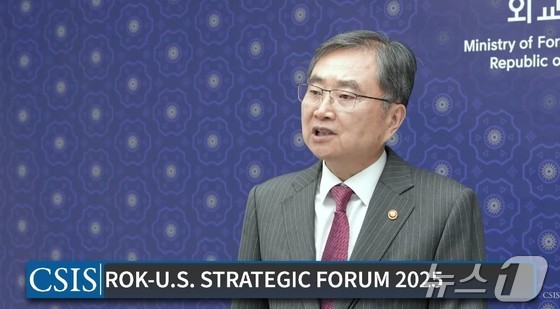
On Wednesday, South Korean Foreign Minister Cho Hyun stated that it’s time to put into action the joint fact sheet from the October U.S.-South Korea summit. He highlighted key follow-up tasks, including resuming dialogue with North Korea, transferring wartime operational control, and cooperating on South Korea’s nuclear-powered submarine development.
Minister Cho delivered a speech at the 10th U.S.-Korea Strategic Forum, co-hosted by the Korea Foundation (KF) and the Center for Strategic and International Studies (CSIS) in Washington, D.C. He noted that he accompanied President Lee Jae Myung during the summit, affirming that the meeting was constructive and demonstrated deep mutual trust between the two leaders.
Cho further stated that it has reaffirmed the commitment to extended deterrence and the continued presence of U.S. troops in South Korea. He expressed South Korea’s resolve to enhance its defense capabilities to lead a combined conventional defense posture against North Korea.
He added that both sides agreed to cooperate on the transfer of wartime operational control.
Minister Cho emphasized that however, deterrence must go hand in hand with diplomacy. He stressed the need to prevent accidental clashes, ease tensions, and restore dialogue with North Korea.
Notably, he pointed out that North Korea’s nuclear and ballistic missile programs remain a serious concern, emphasizing that a denuclearized Korean Peninsula is an essential goal they cannot abandon. He highlighted President Lee’s E.N.D. (Engagement, Normalization, Denuclearization) initiative.
He explained that this initiative aims to break the cycle of deep-rooted hostility and open a realistic path toward lasting peace beyond the Korean Peninsula.
Minister Cho also underscored the importance of alliances amid the rapidly changing international landscape.
He remarked that it must navigate the changing strategic environment, pointing out that Russia’s deepening relationship with North Korea, China’s growing influence, and Japan’s evolving strategic posture all shape the environment they must address. He stated that South Korea aims to manage these changes through a principled approach that reduces strategic risks while strengthening cooperation channels in Northeast Asia.
He continued that cooperation among South Korea, the U.S., and Japan is essential. He emphasized that together, they play a central role in maintaining regional stability and responding to emerging security challenges.
He noted that despite current tensions between China and Japan, South Korea will continue to advance cooperation with both countries within the trilateral (South Korea-U.S.-Japan) framework. He found it encouraging that the Asia-Pacific Economic Cooperation (APEC) summit has set the stage for the first U.S.-China summit under a potential second Trump administration.
Regarding strengthening alliances in the economic and technological fields, he expressed hope that their recent trade and investment agreements are based on the highest level of trust and lay the groundwork for expanded cooperation in shipbuilding, energy, biotechnology, artificial intelligence, and quantum technologies.
On the topic of South Korea’s nuclear-powered submarine development and uranium enrichment, he emphasized the importance of the U.S. decision to support South Korea’s peaceful uranium enrichment and the reprocessing of spent nuclear fuel, as well as President Donald Trump’s support for South Korea’s nuclear-powered submarine development.
He anticipated that these measures will significantly enhance their joint capabilities in next-generation energy, defense, and shipbuilding.
Minister Cho stated that for over 70 years, the U.S.-South Korea alliance has evolved with historical trends, and he expressed the need to maintain that momentum to modernize the alliance.
He reiterated that pragmatism remains the compass of South Korean diplomacy. He emphasized that this spirit guides their efforts to shape the future of the region.