

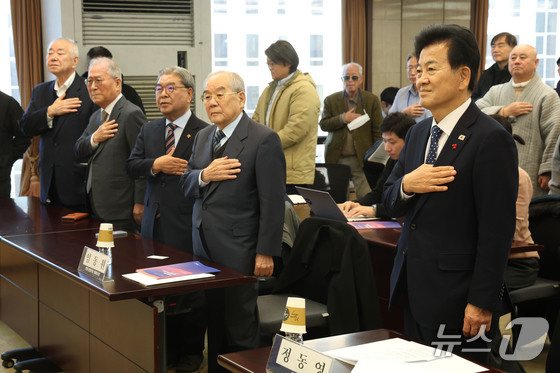
On Thursday, tensions persisted within the government between the self-reliant faction, which emphasizes inter-Korean relations through dialogue, and the alliance faction, which prioritizes diplomatic ties with the U.S. and international community in addressing North Korean issues.
Proposal to Amend the Constitution for Dialogue with North Korea… Criticism Raised Over Undermining National Identity
Moon Chung-in, a professor emeritus at Yonsei University often regarded as the leader of the self-reliant faction, argued during a special forum on inter-Korean relations on Wednesday that discussions to amend Articles 3 (territorial clause) and 4 (establishment of a free democratic unification policy) of the constitution should begin to enable dialogue with North Korea.
He suggested that addressing constitutional issues related to the two-state theory would provide strategic groundwork and direction, more than halting U.S.-South Korea joint military exercises.
This assertion can be interpreted as a call to amend the constitution to acknowledge North Korea’s statehood, which it currently does not.
This aligns with North Korea’s advocacy for the two-state theory since December 2023. As North Korea shows no signs of changing its stance, this argument appears to support the South Korean government’s plan to induce dialogue by presenting a realistic two-state theory. It seems to adopt a strategy of appearing to concede to North Korea’s demands to open channels for dialogue.
However, the proposal to amend the constitution has faced significant criticism. Critics argue that changing the constitution, which requires broad public discussion, is inappropriate for addressing a specific issue like inter-Korean relations, as it touches upon fundamental national identity. They also contend that amending the constitution solely to advance a particular administration’s policy is illogical, given that laws, policies, and social systems are based on the premise that the two Koreas are in a ‘special relationship’ rather than separate states.
It’s crucial to note the stark differences in positions between the self-reliant and alliance factions in this debate.
Unification Minister Chung Dong-young, who attended the forum, has advocated for the realistic two-state theory since taking office. He argues that recognizing the two Koreas as separate entities, given their long-standing activities as such in the international community, is pragmatic and part of a process toward unification, similar to Germany’s experience.
However, National Security Office Chief Wi Sung-lac, leader of the alliance faction, countered in September, stating that the government does not support or recognize the two-state theory. The official stance is that the two Koreas are in a special relationship until unification. This marked a significant point of discord between the self-reliant and alliance factions within the government.
Minister Chung attempted to ease tensions in October, claiming that the government’s diplomatic and security team is entirely self-reliant alliance, but reports indicate that significant disagreements between the two factions persist.
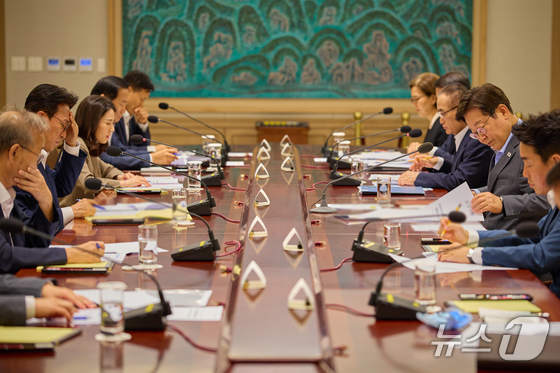
North Korea Objects to Denuclearization Being Included in the E·N·D Concept… New Expression Nuclear-Free Korean Peninsula’ Emerges
After taking office in June, President Lee Jae Myung swiftly implemented a strong conciliatory policy toward North Korea. The self-reliant faction’s argument that eliminating factors that deepened conflicts during the Yoon Suk Yeol administration would help resume dialogue persuaded President Lee. Consequently, measures such as halting loudspeaker broadcasts and controlling the distribution of leaflets to North Korea were enacted.
However, North Korea did not respond positively. On July 28, Kim Yo-jong, a deputy director of the Workers’ Party, stated that its blind faith in the U.S.-South Korea alliance and attempts to confront them are no different from its predecessor’s, asserting that North Korea has no interest in Seoul’s policies or proposals, nor any intention to engage in discussions with South Korea.
This prompted a shift in the government’s stance. At the United Nations (UN) General Assembly in late September, President Lee announced the E·N·D initiative, comprising Exchange, Normalization, and Denuclearization. This initiative reflected a significant portion of the alliance faction’s views on the importance of North Korea’s denuclearization. Despite North Korea’s outright rejection of denuclearization, the initiative aimed to establish a North Korean policy aligned with the international community.
Subsequently, during a South Korea-U.S. summit at the Asia-Pacific Economic Cooperation (APEC) meeting in Gyeongju in late October, the two nations agreed to promote North Korea’s denuclearization. North Korea responded by claiming that the U.S. and South Korea had denied its sovereignty and expressed willingness to confront it.
In response, President Lee, at the launch ceremony for the 22nd Advisory Committee of the Democratic Peace Unification Advisory Council on Tuesday, revealed a new direction for the government’s North Korea policy, using the term nuclear-free Korean Peninsula instead of denuclearization. This shift suggests that the self-reliant faction’s argument against provoking North Korea as it prepares new foreign policies at year’s end was accepted.
Shaking Up the NSC System… Highlighting an Uneasy Coexistence Amid Conflict Rather Than Positive Competition
Although the government denies reports of conflict between the self-reliant and alliance factions, dissatisfaction persists within the self-reliant faction regarding the National Security Council’s (NSC) composition, which is dominated by diplomats. This suggests that underlying tensions remain.
The NSC currently comprises Wi Sung-lac, a diplomat, as the chair, with military officer Kim Hyun-jong as the first deputy (Security and Defense), diplomat Lim Woong-soon as the second deputy (Diplomacy and Unification), and diplomat Oh Hyun-joo as the third deputy (Economics and Cybersecurity). NSC meetings are conducted with the chair, along with the Director of the National Intelligence Service and the ministers of Foreign Affairs, Unification, and Defense, seeking common ground. However, voices within the self-reliant faction argue that this format is inappropriate.
Former Minister Jeong Se-hyun pointed out during the forum that there are three deputy directors under a minister-level security chief. How can it be reasonable for deputy directors to attend and speak on the same level as the heads of the National Intelligence Service and the Unification, Foreign Affairs, and Defense ministries?
Professor Moon Chung-in directly criticized Chief Wi, stating that Wi thinks he is doing well in this role, but he believes some adjustments are necessary. He further asserted that the NSC chair should be the Unification Minister, not the Security Chief, referencing the precedent set when Chung Dong-young held the NSC chair during his tenure as the first Unification Minister in 2006.
Both Professor Moon and former Minister Chung expressed critical views on the E·N·D initiative, likening it to the North Korea Endiesm of the early 1990s. Some interpreted the forum as the self-reliant faction using outside voices to attack the alliance faction.
The presidential office and the government maintain that both factions lack substance and that the diplomatic and security team operates in a complementary competitive relationship. However, within the ministries of Foreign Affairs, Unification, and Security, many assert that the two factions are in a conflict relationship rather than a competitive one.