

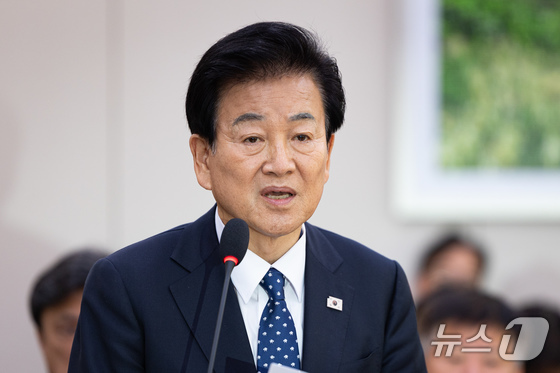
On Monday, Minister of Unification Chung Dong-young emphasized the critical need for establishing an institutional framework to support a new era of peaceful coexistence in inter-Korean relations.
In a congratulatory speech at the Joint Seminar of the Ministry of Unification and the Korean Political Science Association, delivered by Vice Minister Kim Nam-jung on his behalf, Minister Chung stated that consistent policy implementation was key to German unification. It must pursue a stable and continuous North Korea policy that remains steadfast in the face of ideological or partisan conflicts.
Minister Chung highlighted that the immediate challenge is to transform the hostility between North and South into peace. Its priority is to foster a relationship where both Koreas are viewed as peaceful states working towards unification, and to institutionalize this peaceful coexistence.
He drew parallels with West Germany’s approach, noting that it had chosen to effectively recognize East Germany’s statehood in response to the two nations, two peoples theory. West Germany maintained its Eastern Policy, focusing on dialogue and cooperation with East Germany regardless of domestic political shifts, thus paving the way for reconciliation and cooperation.
Minister Chung also referenced past bipartisan agreements such as the National Community Unification Plan and the Basic Agreement between North and South Korea. He emphasized that it must honor these past agreements and establish a normative foundation for peaceful coexistence. This will ensure that inter-Korean relations consistently move towards reconciliation and cooperation, while also creating a legal basis for a sustainable North Korea policy.