

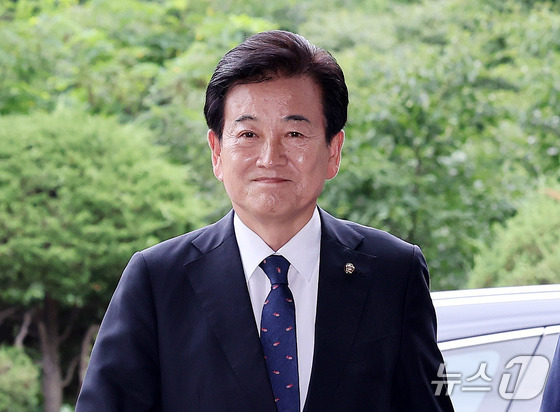
The government anticipates that President Donald Trump’s visit to China next April will be a pivotal moment for dialogue between North Korea, South Korea. South Korea’s Unification Minister Chung Dong-young has repeatedly emphasized that the period leading up to April is critical for peace on the Korean Peninsula, urging that Trump broaden his focus to include the region during his China trip.
This outlook stems from Trump’s statement that he would return to meet Kim Jong Un. During his visit to South Korea for the Asia-Pacific Economic Cooperation (APEC) summit in October, Trump actively sought to engage with Kim, the General Secretary of North Korea’s Workers’ Party.
However, Kim remained silent, effectively rebuffing Trump’s invitation. As Trump departed South Korea, he remarked that he would return, leading the government to anticipate an opportunity in April.
The government also appears to be quietly banking on China’s role. While North Korea and China seemed distant last year, they appear to be rekindling their alliance this year. This has led to speculation that Chinese President Xi Jinping might facilitate North Korean-U.S. dialogue to improve relations with Washington.
Five Months of Battle is the Buzzword at the Ministry of Unification… Signs of Concrete Progress in U.S. Policy Toward North Korea are a Green Light
A Unification Ministry official recently used the term five-month battle to underscore the government’s commitment to securing dialogue with North Korea by April. This language, reminiscent of North Korea’s speed battle campaigns, reflects the urgency and determination of the effort.
While five-month battle isn’t official terminology, it clearly indicates the government’s recognition of April’s significance. The ministry is encouraged by recent indications that the U.S. is moving to formalize its North Korea policy under Trump’s second term.
South Korea and the U.S. are considering regular policy discussions on North Korea. Diplomatic circles expect that following the release of its National Security Strategy (NSS), the Trump administration will soon formalize its North Korea policy after announcing a new National Defense Strategy (NDS).
The appointment of a U.S. Special Representative for North Korea Policy would signal that preparations are complete for April.
The government aims to make next year transformative for inter-Korean relations, prepared for a grueling five-month battle. National Security Office head Wi Sung-lac outlined this vision, stating the government will actively promote peace and coexistence on the Korean Peninsula, serving as a pacemaker by communicating closely with North Korea and the U.S. and implementing trust-building measures.
However, North Korea shows no signs of engaging in dialogue. State media, including the Rodong Sinmun, continue to focus on domestic achievements and unity. North Korea’s previously aggressive rhetoric and provocations have become rare.
On Tuesday, North Korea began a year-end plenary meeting to evaluate this year’s activities and prepare for the upcoming Party Congress. Many in the government believe that without a significant turning point, North Korea will continue to position itself as antagonistic towards South Korea and maintain a cold relationship with the U.S.
Bringing North Korea to the negotiating table by April requires a unified approach. However, neither the U.S. nor South Korea has established a cohesive North Korea strategy. The ongoing discussions about pro-independence and pro-alliance factions suggest internal divisions, raising concerns.
Given the strong determination but unfavorable circumstances, the government’s five-month battle may prove challenging. Regardless of the dialogue’s outcome, one can only hope that significant national interests will be served after this intense effort.