

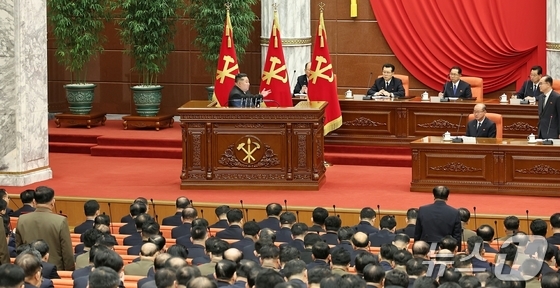
North Korea convened a year-end plenary meeting to assess this year’s party and state activities and to finalize preparations for next year’s 9th Party Congress. Notably, the reports on the plenary meeting did not include any external strategies or messages aimed at South Korea or the United States.
The party’s official newspaper, Rodong Sinmun, reported on Friday that the expanded meeting of the 13th plenary session of the 8th Central Committee was held from Tuesday to Thursday.
The meeting approved five agenda items: the implementation of this year’s policies, the work of the Central Inspection Committee, preparations for the 9th Party Congress, the national budget, and organizational matters. Chairman Kim Jong Un highlighted achievements, including increased industrial and agricultural production, expanded grain harvests, and the completion of local development projects, declaring the five-year plan fulfilled. He also criticized shortcomings in some party organizations and economic institutions, demanding greater accountability and discipline from officials.
Chairman Kim specifically emphasized agricultural and rural issues as key priorities. He directed efforts to expand wheat cultivation, enhance processing capabilities, reform distribution systems, and modernize reclaimed-land farms. He stressed that policy efforts must be intensified until a fundamental change in dietary structure is achieved, firmly establishing increased agricultural production as a national priority.
Regarding local development policies, Kim confirmed the selection of 20 cities and counties for development in 2026. He cited examples from Gangwon Province and South Pyeongan Province, urging each province, city, and county to achieve results tailored to their unique characteristics.
Kim also proposed improving living conditions in coal mining regions as a critical national task, hinting at potential additional investments next year. He emphasized that economic self-reliance would be difficult to achieve without transforming coal mining communities. In addition, the meeting outlined various tasks, including expanding educational infrastructure, strengthening financial and trade regulations, and enhancing environmental protection.
The plenary meeting finalized the 2026 national budget draft for submission to the Supreme People’s Assembly and addressed organizational matters, including changes to some Central Committee members and candidates. Discussions also covered the formation of a preparatory committee for the Party Congress, drafting amendments to the party constitution, and determining the method for electing representatives, thus formalizing the preparation process for the 9th Party Congress.
North Korea focused on evaluating internal challenges related to the economy, agriculture, and local development during this plenary meeting. Notably, the meeting’s outcomes did not include any messages directed at the United States or South Korea, nor did they mention relations with allied nations such as China and Russia. It remains unclear whether these topics were not addressed during the meeting or were discussed but omitted from the official reports.