

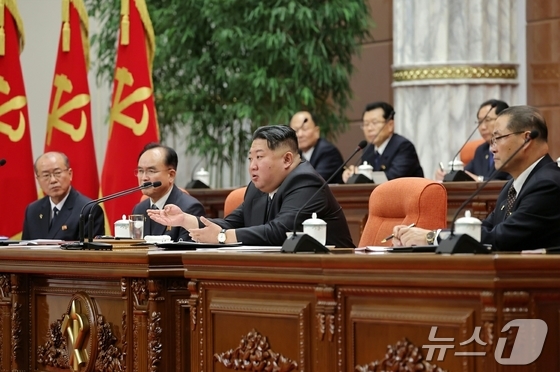
North Korea convened its year-end Workers’ Party plenary meeting to review this year’s party and state activities and finalize preparations for the upcoming 9th Party Congress next year. Notably, the reports following the plenary session did not mention any external strategies, including messages directed at South Korea or the United States. However, they hinted at potential revisions to the party charter during the 9th Congress, raising questions about whether the hostile two-state theory will be formally incorporated.
On Friday, the party’s official newspaper, Rodong Sinmun, reported on the expanded meeting of the 13th plenary session of the 8th Central Committee, which took place over three days from Tuesday to Thursday. Central Committee members and candidate members attended the meeting, leaders from provincial and central agencies, city and county party secretaries, people’s committee chairpersons, and key party and administrative leaders of factories and enterprises, as well as military commanders. An executive body was elected for the plenary session, with Kim Jong Un presiding over the meeting.
During this plenary meeting, participants approved five agenda items: the status of policy implementation this year, the work of the Central Inspection Committee, preparations for the 9th Party Congress, the execution of the 2025 budget and the 2026 budget proposal, and organizational matters.
North Korean leader Kim Jong Un emphasized the completion of the five-year plan, declaring this year as one of confidently crossing the final line with accelerated progress and doubled self-reliance. He claimed that the five-year national economic development plan has been fulfilled. The newspaper reported that the industrial sector met its increased production targets by boosting output and conserving resources, while the agricultural industry achieved higher grain yields than last year. They also noted that the completion of major construction projects contributed to economic development goals.
The meeting highlighted the initiation and completion of local development policy projects, hailing them as achievements to take pride in, helping realize the people’s ideals and welfare. They asserted that the modernization of the people’s economy and the strengthening of technological infrastructure have entered a consolidation phase, providing a foundation for achieving future goals.
The meeting also cited progress in military modernization. The newspaper reported that, in line with the party’s modernization policy, notable achievements had been made in strengthening national defense capabilities and that key national security challenges had been addressed amid changing global geopolitical and technological conditions.
Regarding the deployment of North Korean troops to Russia, the report stated that various branches of the armed forces participated in overseas military operations over the past year, portraying this as evidence of the military’s role as a defender of international justice.
Achievements in sports were also mentioned. The newspaper reported positive results in the sports sector, linking them to an elevation of national standing. It attributed this year’s achievements to ideological strength and stressed the importance of maintaining ideological consistency and a distinct approach in addressing future challenges.
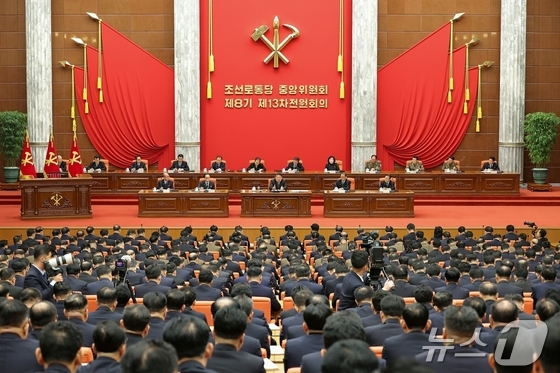
The meeting also addressed party discipline and criticized incorrect ideological perspectives among officials, emphasizing agricultural reform as a top priority.
Kim criticized shortcomings exposed in certain party organizations and economic institutions, condemning officials for flawed ideological views and passive, irresponsible work attitudes. He called for the elimination of negative practices and emphasized the establishment of stronger internal discipline.
Reports from the Central Inspection Committee indicated that biased issues arose during the discipline-building process. This reflects measures to strengthen organizational and disciplinary arrangements ahead of next year’s party congress, with a focus on comprehensive reforms in areas such as grain production, processing, distribution, and land reclamation.
Kim emphasized agricultural and rural sector reforms as the national priority for next year. He instructed significant expansions in wheat cultivation areas, increased wheat processing capabilities, reforms to distribution systems, and the modernization of reclaimed-land farms along the western coast. He particularly called for establishing a system that thoroughly adheres to the principles of socialist distribution concerning distribution system reforms.
North Korea has confirmed 20 cities and counties as targets for local development policy. Kim’s initiatives drive this expansion of regional development policy initiatives. He cited examples such as the construction of six power plants in Gangwon Province and the modernization of the Eunsan Paper Factory in South Pyeongan Province, instructing each province, city, and county to create results that match their unique characteristics.
The improvement of living conditions in coal mining regions was also presented as a national priority. Additionally, tasks for each sector were outlined, including strengthening educational foundations, establishing financial and trade regulations, and protecting the environment.
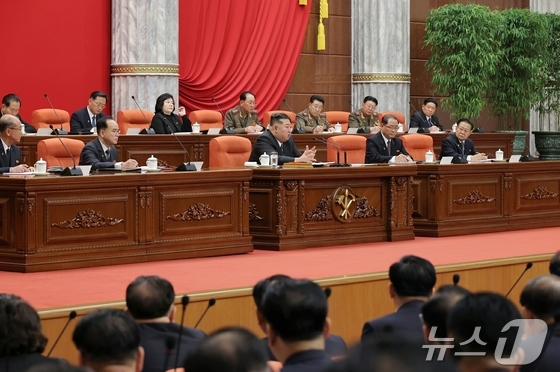
The plenary meeting officially began preparations for the Congress with budget and organizational adjustments, while omitting external strategies from the reports.
The meeting confirmed the national budget proposal for 2026, to be submitted to the Supreme People’s Assembly. It carried out organizational restructuring by recalling one member and five candidate members of the Central Committee. The details of the personnel changes have not been disclosed.
The newspaper reported that preparations for the 9th Party Congress include forming a preparation committee, drafting amendments to the party charter, summarizing the work of party committees at all levels, and discussing methods for electing representatives, indicating that the preparations are now in full swing. This suggests that charter amendments may be pursued again, following the 7th Congress in 2016 and the 8th Congress in 2021.
Observers are closely watching whether North Korea will codify the hostile two-state theory toward South Korea in the party charter. Many experts have previously predicted that Pyongyang would further formalize its hostile stance toward Seoul.
The report contained no references to neighboring countries such as the United States or South Korea, nor did it address relations with China and Russia or assessments of the international environment. This raises questions about whether North Korea is concentrating its policy efforts on internal matters and organizational restructuring rather than external engagement, or whether discussions on external strategy occurred during the meeting but were intentionally excluded from the report.
Compared to past year-end plenary reports, this one provided only general mentions without detailed specifics in various sectors. This clearly indicates that this plenary meeting aims to prepare for the 9th Party Congress, with specific policy directions likely to be discussed during the Congress.