

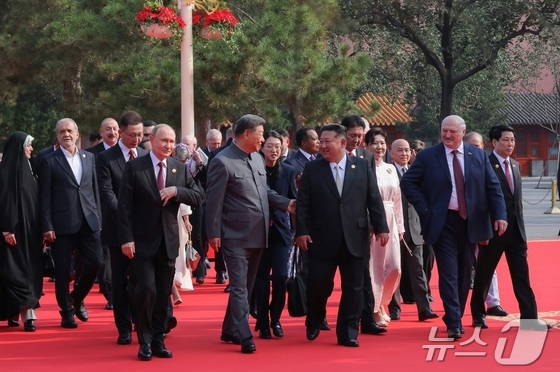
Following the U.S.–South Korea summit in Gyeongju on October 29, North Korea has intensified its focus on the geopolitical rivalry between the U.S.–South Korea–Japan alignment and the bloc comprising North Korea, China, and Russia. Experts suggest that Pyongyang may seek technical assistance related to nuclear submarine technology from Beijing and Moscow as part of its response to shifting regional dynamics.
On Thursday, Cho Jang Won, a visiting researcher at the Sejong Institute, released a report titled “North Korea’s Military Cooperation Prospects with China and Russia Post U.S.-South Korea Summit,” offering this strategic analysis.
Cho’s analysis of commentaries published by the Korean Central News Agency after the summit indicated that North Korea is primarily concerned about the expansion of U.S. military influence in the Indo-Pacific region through alliances with South Korea and Japan.
In a November 18 commentary, Pyongyang criticized the reaffirmation by U.S., South Korean, and Japanese leaders of their commitment to the complete denuclearization of North Korea during the Asia Pacific Economic Cooperation summit in Gyeongju. The regime argued that this demonstrated the true nature of Washington’s North Korea policy.
10 days later, on November 28, North Korea issued another statement condemning the joint U.S.–South Korea anti-submarine exercise known as Silent Shark, conducted near Guam on November 18, as well as the establishment by the U.S. Marine Corps of a forward arming and refueling point on Yonaguni Island near the Taiwan Strait on November 21. Pyongyang viewed these actions as further evidence of deepening military cooperation among the United States, South Korea, and Japan.
Cho highlighted that North Korea perceives U.S. efforts to regionalize and coordinate its alliances with South Korea and Japan as an attempt to encircle China and Russia, drawing parallels to NATO’s structure.
He explained that North Korea’s November 18 commentary, which pledged to take more justifiable and practical measures to defend national sovereignty, security interests, and regional peace, likely signals an intention to strengthen security cooperation with China and Russia.
Cho further predicted that North Korea might request critical technologies for developing nuclear submarines or strategic weapons from China and Russia, motivated by South Korea’s advancements in uranium enrichment and spent nuclear fuel reprocessing capabilities.
However, he cautioned that while China may see a need to strengthen its anti-U.S. stance and relations with North Korea have improved since Kim Jong Un’s attendance at Chinese Victory Day celebrations, current U.S.-China military tensions don’t justify substantial support for North Korea’s advanced weapons development.
He also assessed that, despite Russia’s comprehensive strategic partnership treaty with North Korea last June, which effectively formed a military alliance, Moscow is unlikely to provide submarine technology in the near term.
Nevertheless, Cho added that both China and Russia likely share North Korea’s perspective on U.S.-South Korea-Japan military collaboration. He suggested that if U.S. regional hegemony intensifies, North Korea’s strategic value could increase, potentially reshaping regional geopolitics.
Cho emphasized that in a scenario of extreme U.S.-China conflict over Taiwan, Beijing’s need for military cooperation with Pyongyang could significantly escalate.