

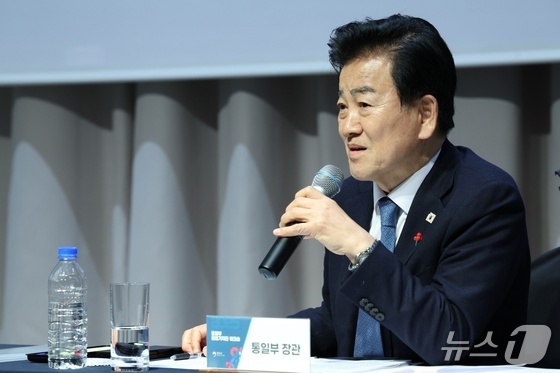
South Korea’s Minister of Unification, Chung Dong Young, has openly challenged the U.S. position that increasing pressure on North Korea through sanctions and human rights issues would strengthen negotiating leverage. His remarks followed a recent dispute with the United Nations Command over access to the Demilitarized Zone. They stood in sharp contrast to the current U.S. approach toward North Korea, as articulated by Kevin Kim, the U.S. deputy ambassador to South Korea.
At a press conference held during a Ministry of Unification workshop in Goyang, Gyeonggi Province, on Wednesday, Chung said that while some argue tougher sanctions and a stronger emphasis on human rights would improve negotiating leverage, the opposite approach should also be considered.
He said that over the past 20 years of nuclear negotiations with North Korea, there have been four phases of dialogue and four phases of sanctions, pressure, and isolation. Chung noted that North Korea’s nuclear and missile capabilities advanced during periods marked by sanctions and isolation, adding that North Korean officials have consistently emphasized national pride and rejected dialogue conducted under pressure.
He stressed the importance of implementing effective peace measures by understanding the historical context of inter-Korean relations and objectively assessing North Korea’s perceived threats.
During a courtesy visit on November 25, Deputy Ambassador Kevin Kim conveyed President Donald Trump’s desire to negotiate with North Korea from a position of strength, suggesting that maintaining sanctions and addressing human rights issues would enhance negotiating power.
Chung’s remarks clearly expressed the Unification Ministry’s disagreement with this U.S. approach. They also counter arguments from pro-alliance voices within the government that advocate close alignment with the United States and the international community on North Korea policy. Chung is widely regarded as part of an independent camp that prioritizes resolving Korean Peninsula issues primarily through inter-Korean relations.
On December 3, during a legislative hearing on the preservation and use of the Demilitarized Zone, Chung strongly criticized the United Nations Command for denying access to the White Horse Ridge excavation site and barring his visit to Daeseong-dong village, calling the decision unacceptable for a sovereign nation.
Observers interpret Chung’s public dissatisfaction with the U.S. approach, which opposes unilateral concessions, as significant. This is especially notable given that the U.S. Forces Korea commander also leads the UN Command, and past conflicts between the government and the UN Command occurred during the Moon Jae In administration.
Regarding South Korea–U.S. joint military exercises, Chung said suspending the drills had previously advanced nuclear negotiations in the 1990s and helped create diplomatic momentum in 2018. He added that joint exercises should be viewed as a means to achieve peace rather than an end in themselves, a position that differs from that of pro-alliance officials.
Earlier, Wi Seong Rok, director of South Korea’s National Security Office, stated that adjusting or reducing joint exercises is not considered a tool for advancing denuclearization on the Korean Peninsula.
Chung said April next year could be a turning point for peace on the Korean Peninsula and reiterated the goal of achieving a nuclear-free peninsula. He acknowledged differing views within the government on North Korea policy, noting that the defense, foreign affairs, and unification ministries each have distinct roles and that integrating those perspectives remains a shared responsibility.
Chung also raised concerns about the current structure of the National Security Council, describing it as unusual and potentially problematic under administrative law, and said President Lee Jae Myung is aware of the issue.
This aligns with views expressed by senior members of the independent faction, who recently criticized the NSC structure, suggesting that the Unification Minister should chair the NSC permanently.
Chung noted that while the Lee Jae Myung administration characterized the United States as a peacemaker and South Korea as a pacemaker, that role has yet to be fully realized. He said efforts to rebuild trust will intensify next year.
He added that President Trump’s planned visit to China in April could serve as a turning point for peace, stressing the need to create conditions for dialogue and pursue proactive peace measures while maintaining the long-term goal of a nuclear-free Korean Peninsula.
Regarding the possible restoration of the September 19 inter-Korean military agreement, Chung said the issue remains under strategic consideration, with the timing yet to be determined.
Addressing the principle of peaceful coexistence between two states, Chung said the concept reflects a broad public consensus. He cited a recent Ministry of Unification survey showing that 79.4 percent of respondents prioritize peaceful coexistence over unification.