

North Korea staged an elaborate welcome ceremony for its engineering unit returning from a mine-clearing mission in Russia. Kim Jong Un, the Supreme Leader of the Workers’ Party, personally presided over the event. He declared that sacrificing one’s life for the nation is not a sacrifice but an honor. Critics on December 14 pointed out that this rhetoric reveals North Korea’s use of fallen soldiers as tools for state propaganda.
The Workers’ Party’s official newspaper, Rodong Sinmun, reported on December 13 that a homecoming ceremony for the Korean People’s Army’s 528th Engineering Regiment was held on the 12th at Pyongyang’s April 25 House of Culture square. The paper lauded the unit, which was formed on May 27 and deployed to Russia’s Kursk region in early August, for their outstanding performance in combat engineering operations.
Korean Central Television broadcast an extensive 40-minute segment covering the ceremony. The event kicked off as Pyongyang residents of all ages waved flags and cheered when buses carrying the returning troops arrived at the square, indicating a massive turnout for the occasion.
Following the troops’ arrival, Party Central Committee officials, Defense Ministry brass, and People’s Army commanders entered the square. Last to appear was Supreme Leader Kim, clad in a black leather coat, who received a thunderous welcome.
Kim took the podium with a grave expression. In his address, he welcomed the returning soldiers and highlighted the deployed unit’s achievements.
Kim also disclosed for the first time that nine soldiers had perished during the mission, likely in explosions during mine-clearing operations. Previously, on November 14, Russian defense ministry outlets and local media had released footage showing North Korean engineers conducting joint mine-clearing operations with Russian forces on the Kursk front lines.
Kim praised the fallen, stating that in the unforgiving battlefield where even the slightest error is fatal, these heroes put their comrades first, shielding them with their bodies and fulfilling their duty to the last breath even when mortally wounded. Such dedication commands universal admiration. He lauded the deceased soldiers for their heroic actions, terming it mass heroism.
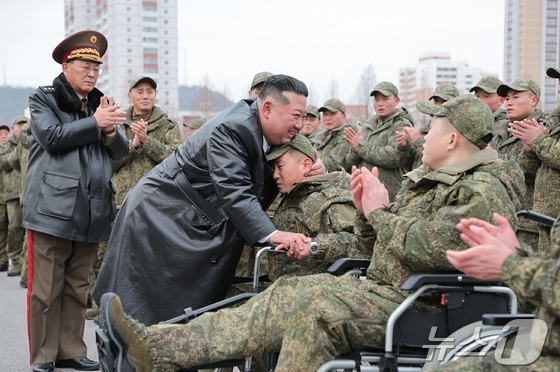
After his speech, Kim stepped down from the podium to personally shake hands with each combatant, even bending down to embrace a soldier in a wheelchair. He then posed for a group photo with all the troops, with soldiers flanking Kim holding portraits of the nine fallen comrades.
Korean Central Television also showed Kim visiting the Wall of Remembrance in the main hall of the April 25 House of Culture. There, he pinned medals on the portraits of the fallen, knelt to lay flowers, and observed a moment of silence. According to the broadcast, the nine fallen soldiers will be posthumously awarded the title of Hero of the Republic, the First-Class National Flag Order, and the First-Class Order of Military Merit.
Family members of the deceased were seen weeping before the Wall of Remembrance, tenderly touching photos of their lost loved ones. However, moments later, when it was time for soldiers to pay their respects, footage captured troops forcibly removing the grieving families.
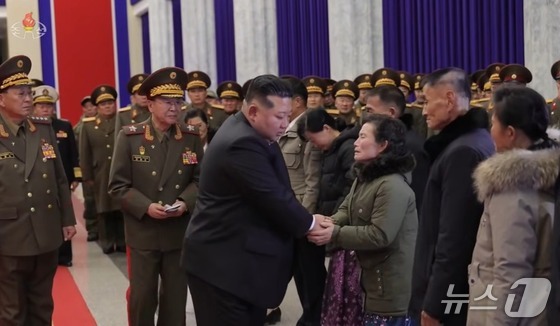
When it came time for Kim to console the bereaved families, they were required to stand at attention despite their grief. Kim personally held the hand of each family member, offering individual condolences. One student, likely a member of the youth league, drew attention by standing ramrod straight and saluting Kim while tears streamed down his face.
In another instance, when an individual collapsed in front of Kim overcome with emotion, Party Deputy Director Hyon Song-wol quickly approached, helped them up, and whispered something, after which they immediately regained composure. A North Korean defector speculated that Hyon likely reminded them to maintain composure in front of the Supreme Leader. This incident underscores that even families of those forcibly deployed and killed cannot escape the regime’s oppressive control.
These bereaved families were also invited to attend a celebratory concert for the returning soldiers, with Kim in attendance. When images of the fallen appeared on the massive screen on stage, the families once again broke down in tears, a moment broadcast live on television. This further demonstrates North Korea’s exploitation of deployed soldiers and the fallen as propaganda tools to bolster national unity and tout the regime’s supposed superiority.
South Korea’s National Intelligence Service estimates that since October of last year, approximately 15,000 North Korean combat troops have been deployed to Russia, with around 2,000 presumed dead. As North Korea has yet to announce the complete return of all deployed combat units, the casualty count is expected to rise.
Throughout this year, North Korea has repeatedly labeled the deployed soldiers and the fallen as national heroes in an effort to stoke patriotism and loyalty among its populace. With the 9th Workers’ Party Congress approaching early next year, Pyongyang is likely to intensify this propaganda campaign to achieve its political objectives.
Some analysts suggest that North Korea’s grandiose events honoring the deployed soldiers and linking their service to national identity may be a calculated move by Kim to demand greater compensation from Russia.