

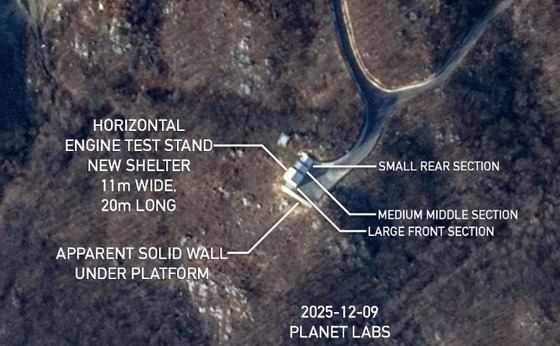
On December 12, U.S. intelligence sources confirmed that North Korea has upgraded the engine combustion test stand at its West Sea Satellite Launch Site, a key facility for developing long-range missiles. The modernized equipment is believed to enhance the efficiency of engine combustion tests.
NK News, a U.S.-based media outlet focusing on North Korean affairs, reported that satellite imagery from Planet Labs captured on December 9 revealed a significant modification. The horizontal test stand, used for solid-fuel engine tests applicable to both missiles and space launch vehicles, now features a foldable cover instead of the previous fixed structure.
The new cover appears to be designed with three sections that can open and close. This upgrade marks a substantial improvement in operational capabilities. Previously, large engines had to be manually maneuvered off trucks and onto the test stand, a process fraught with potential risks. The foldable cover now allows for crane-assisted installation, significantly reducing the chances of accidental damage during engine placement.
NK News analysts also noted increased activity at the vertical test stand, separate from the horizontal facility. This suggests that North Korea is conducting comprehensive testing on various engine types, potentially for different missile systems.
In a related development, North Korean leader Kim Jong Un personally observed tests of a new solid-fuel engine during a September visit to a missile research institute. This engine, crafted from carbon fiber composites, is reportedly designed for the new Hwasong-20 Intercontinental Ballistic Missile (ICBM). The use of carbon fiber technology is a significant advancement, promising reduced weight and increased structural integrity for both engines and missiles.
Pyongyang has stated its intention to integrate this new solid-fuel engine into both the improved Hwasong-19 ICBM, which has already undergone test launches, and the yet-to-be-tested Hwasong-20 ICBM.
North Korea’s most recent ICBM test, involving the Hwasong-19, took place on October 31 last year. While the regime showcased the exterior of the Hwasong-20 during a military parade celebrating the Workers’ Party founding in October, it has not yet conducted a test launch. Defense analysts speculate that as the development of the new solid-fuel engine nears completion, a test launch could be scheduled to coincide with the 9th Workers’ Party Congress next year, potentially serving as a show of technological prowess and military might.