The Lee Jae Myung administration and Donald Trump’s potential second term are set to begin regular consultations on North Korea policy starting Tuesday. Jeong Yeon-du, head of the Diplomatic Strategy and Information Bureau at the Ministry of Foreign Affairs, and Kevin Kim, the U.S. Deputy Ambassador to South Korea, will serve as the chief representatives for their respective nations. However, as of Monday, significant disagreements within the government regarding the Ministry of Unification’s participation in these meetings have been confirmed.
The Ministry of Unification reportedly believes that coordinating North Korea policy through a consultative channel is fundamentally inappropriate. They have suggested that changing the meeting’s name is necessary. The Ministry particularly views these regular meetings as a revival of the working group established during the 2018 denuclearization negotiations, arguing that it is inappropriate for the U.S. to act as the de facto approving authority for inter-Korean cooperation and exchanges.
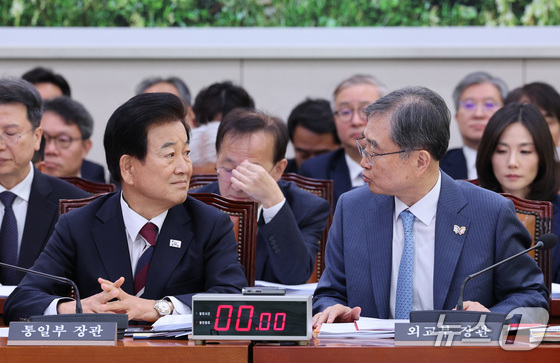
The Ministry of Unification expresses concerns about the U.S.’s excessive involvement in establishing inter-Korean relations. According to government officials, the Ministry plans to hold a senior officials’ meeting chaired by Minister Chung Dong-young on Tuesday morning to make a final decision on whether to participate in the regular meetings with the U.S.
Unification Ministry spokesperson Yoon Min-ho indicated during a regular briefing that while the Ministry of Foreign Affairs typically handles U.S.-South Korea relations, the Ministry of Unification can also communicate regarding North Korea relations depending on the issue. This statement suggests disagreement with the Foreign Ministry’s leading role in North Korea policy discussions.
The working group that the Ministry of Unification has raised concerns about was established in 2018 as a communication channel between diplomatic authorities, involving relevant departments centered around the Foreign Ministry and the State Department. It served as a unified communication channel to share information and discuss necessary matters for inter-Korean cooperation projects during the North Korea-U.S. denuclearization negotiations.
However, the U.S. has expressed concerns that inter-Korean cooperation projects are progressing more quickly than denuclearization negotiations. They have voiced negative opinions through the working group regarding the modernization of inter-Korean rail and road projects and raised the possibility of violating sanctions concerning trucks intended for flu treatment supplies headed to North Korea. This has led to significant dissatisfaction within the Ministry of Unification regarding the U.S.’s skeptical stance on inter-Korean exchanges.
In this context, the Ministry of Unification appears to have expressed the need to change the name of the meetings and to ensure that discussions occur on an equal footing between South Korea and the U.S. Reports indicate that during a recent National Security Council (NSC) meeting, the Foreign Ministry and the Ministry of Unification presented conflicting opinions on this issue. They emphasized that the regular consultations should not repeat the precedent set by the 2018 working group, which effectively transformed into a structure requiring U.S. approval.
The Standoff Between the Pro-Independence Faction and the Pro-Alliance Faction Persists… What is President Lee’s Stance?
This controversy stems from a rivalry between two factions within the Lee administration: the independent faction, led by National Intelligence Service Director Lee Jong-seok and Minister Chung, who advocate for a bilateral approach to inter-Korean relations, and the alliance faction, which argues for a North Korea policy coordinated with the international community, particularly the U.S. Key figures from the diplomatic community, such as National Security Office Director Wi Seong-lac and Foreign Minister Cho Hyun, are part of the alliance faction.
The two factions clash over the operation of the NSC, which is staffed entirely by diplomats under Director Wi, and they hold opposing views on maintaining sanctions against North Korea and pressuring for human rights issues. The independent faction advocates for a softer approach, while the alliance faction argues for maintaining the current stance. Regarding the issue of two states as claimed by North Korea, the independent faction promotes a realistic two-state theory, while the alliance faction contends that the concept of two states cannot be recognized under the constitution.
President Lee has aligned with the alliance faction’s position during diplomatic engagements, such as the U.S.-South Korea summit and speeches at the United Nations (UN) General Assembly. Decisions on North Korea’s appeasement measures that the government can undertake have also been based on the alliance faction’s stance. For instance, during the U.S.-South Korea summit, he maintained the joint position on North Korea’s denuclearization, yet used the term nuclear-free Korean Peninsula during the inauguration ceremony of the 22nd Advisory Committee of the Democratic Peace and Unification Advisory Council, reflecting a slightly different nuance.
However, experts consistently point out that it is now more crucial for the government to present a unified voice. They argue that it is inappropriate for the president to neglect the situation where differences in positions escalate into conflict, especially when there are already indications of disagreement within the government.