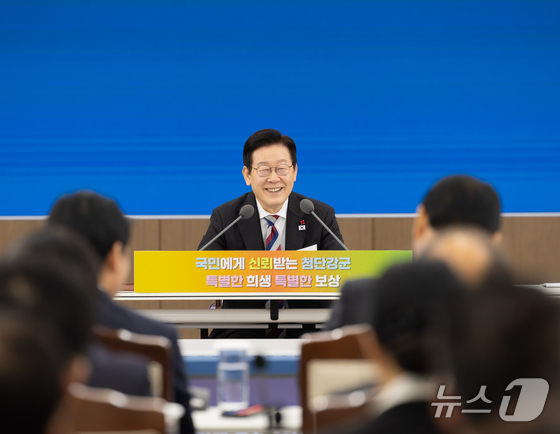
On December 19, President Lee Jae Myung addressed inter-Korean relations, stating that it must proactively and patiently lead efforts to ease hostilities between North and South Korea, fostering even a small seed of trust. He believes this crucial role falls to the Ministry of Unification.
During a briefing at the Government Seoul Complex with officials from the Ministries of Foreign Affairs and Unification, Lee remarked that while improving inter-Korean relations is undoubtedly challenging, it’s not a task that can be abandoned.
Lee devoted most of his opening remarks to assessing the North Korean situation and inter-Korean relations. By emphasizing the Ministry of Unification’s role at the end, he effectively positioned it as the key department to implement his vision, seemingly resolving recent tensions between the Unification and Foreign Affairs ministries over North Korea policy leadership.
The President emphasized that as he’s mentioned before, it needs to find even the smallest opening for communication, dialogue, cooperation, and a path toward coexistence and mutual prosperity between North and South. Currently, it doesn’t have even that tiny opportunity. He added that it must now regain its footing. It needs to patiently work to improve the situation where North Korea fundamentally rejects any contact.
Regarding the Foreign Ministry, Lee noted that it appears that even the current global economic order heavily relies on diplomacy. The same applies to security issues. He added that while peace is the most reliable security policy, even peace is greatly influenced by diplomatic efforts.
Lee continued that in today’s intensely competitive global economy, he believes diplomacy plays a crucial role in expanding the economic reach. The overseas missions should serve as bridges and spearheads for cultural outreach and economic expansion. He urged the Foreign Ministry to focus on broadening South Korea’s global presence rather than solely concentrating on North Korea policy.
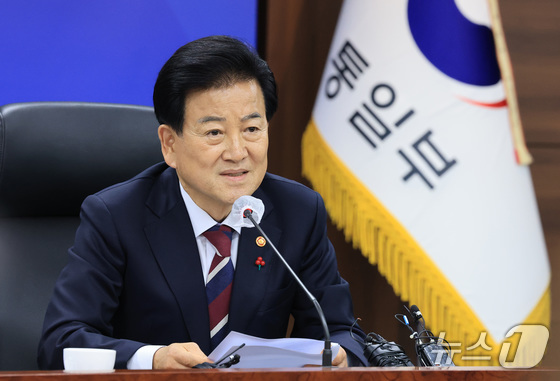
Both ministries aligned their reports with the President’s stance. Unification Minister Chung Dong-young proposed creating a Special Envoy for Peace on the Korean Peninsula to oversee North Korea policy and coordinate with the U.S.
This proposal suggests establishing a new position to manage North Korea issues at a higher level or separately from the current structure, where the National Security Office Director Wi Seong-lac heads the National Security Council, and the Foreign Ministry’s Strategic Planning and Information Bureau chief handles North Korea negotiations.
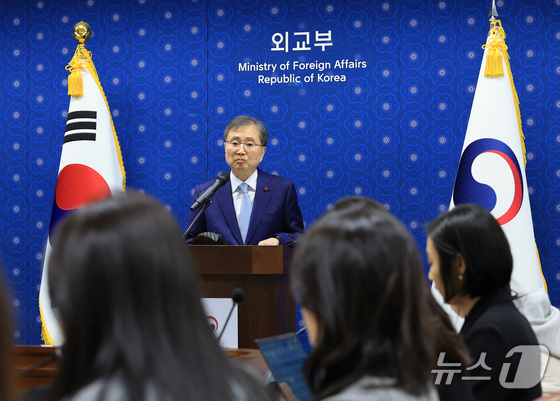
Foreign Minister Cho Hyun stated that the Foreign Ministry will make every diplomatic effort to turn the Unification Ministry’s proposals into reality. He added that it will carefully review various ambitious goals to gain international support and, most importantly, elicit a response from North Korea. This clearly indicates that the Foreign Ministry will provide diplomatic support for policies established under the Unification Ministry’s leadership regarding North Korea.
Minister Cho also noted that who leads the policy isn’t as important as achieving results. Depending on the situation, the Foreign Ministry might take a leading role, but if rapid progress allows for direct talks with North Korea, the Unification Ministry should take the lead.
The two ministries plan to coordinate through regular executive meetings, with Jeong Yeon-du, head of the Foreign Ministry’s Strategic Planning and Information Bureau, and Kim Nam-jung, Deputy Minister of Unification, serving as counterparts.
Minister Chung also announced plans for regular consultations with the U.S. Embassy at the chargé d’affaires level, indicating ongoing communication with the U.S.