

The Ministry of Unification has unveiled ambitious plans to make 2026 the inaugural year of peaceful coexistence on the Korean Peninsula, proposing innovative solutions for inter-Korean relations. The ministry aims to implement a three-phase approach that would enable South Koreans to visit North Korea’s expansive Wonsan-Kalma tourist zone, while also developing a novel peace trade system to expand humanitarian cooperation despite existing sanctions.
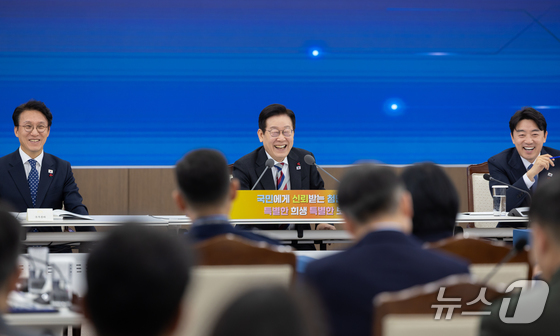
On December 19, Unification Minister Chung Dong-young presented the Ministry’s 2026 work plan to President Lee Jae Myung at an international conference room in the Seoul Government Complex.
The five key initiatives introduced include: 1) Resuming dialogue between North and South Korea and institutionalizing peaceful coexistence; 2) Exploring creative approaches for new exchanges and cooperation; 3) Fostering peace in border areas and revitalizing local economies; 4) Addressing the hardships of division and resolving humanitarian issues; and 5) Broadening public engagement to build consensus on peace and unification.
The Ministry Envisions Connecting Seoul, Pyongyang, and Beijing via Rail and Developing Tourism Routes from Sokcho to Wonsan
Starting next year, the Ministry of Unification aims to rekindle inter-Korean exchanges through reciprocal, multilateral, and groundbreaking cooperation. As an innovative approach, the ministry proposed an International Wonsan-Kalma Peace Tourism initiative with a three-phase strategy. Initially, overseas Koreans will be allowed individual visits. The second phase will introduce transit tourism among South Korea, North Korea, and China. The final phase will promote tourism for South Korean citizens. The ultimate goal is to enable South Koreans to travel directly from Sokcho to Wonsan by ferry for tourism purposes.
The ministry also unveiled plans for a high-speed rail line connecting Seoul and Beijing through North Korea. The ambitious project aims to construct 410 kilometers (about 255 miles) of rail, including a 224-kilometer (about 139 miles) stretch linking Pyongyang and Sinuiju, and a 186-kilometer (about 116 miles) section between Kaesong and Pyongyang. This aligns with China’s Belt and Road Initiative and addresses the economic revitalization needs of Northeast China, while also accommodating North Korea’s aspirations for high-speed rail infrastructure.
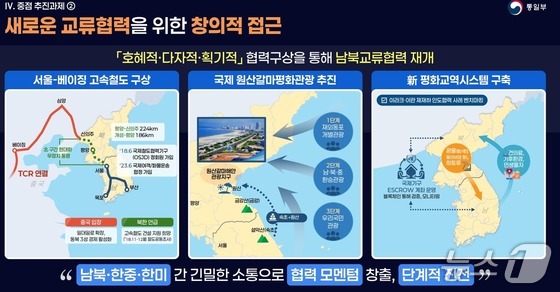
To establish the new peace trade system, South Korea would purchase North Korean minerals such as iron, coal, and molybdenum at international market rates. The funds would then be managed through an escrow account overseen by international organizations, allowing North Korea to procure healthcare supplies, climate-related goods, and essential commodities. This innovative approach draws inspiration from U.S. cooperation with Iraq and Iran despite sanctions, utilizing blockchain technology to ensure transparency in financial and goods transactions among international stakeholders.
The ministry’s agenda also includes preparations for healthcare and medical cooperation. With North Korea declaring this year as the beginning of a healthcare revolution, the ministry plans to develop targeted healthcare cooperation packages, such as modernizing local military hospitals. Additionally, it aims to establish a trust fund for disease eradication and medicine supply. Other initiatives include fostering multilateral cooperation for carbon neutrality between the two Koreas and implementing satellite-based disaster response collaboration.
During the briefing, Minister Chung referenced Kim Jong Un’s 2019 New Year’s address, where he expressed willingness to resume operations at the Kaesong Industrial Complex and Mount Kumgang tourism without preconditions. Jeong acknowledged that the failure to respond promptly at that time was a strategic misstep.
The Ministry of Unification stated its commitment to swiftly promote the resumption of activities at the Kaesong Industrial Complex and Mount Kumgang tourism once dialogue between the two Koreas or between North Korea and the U.S. resumes. The ministry is particularly focused on developing tourism programs that integrate Mount Kumgang with North Korea’s Wonsan-Kalma region, and plans to propose visits by South Korean entrepreneurs to assess the situation in the Kaesong Industrial Complex.
The ministry is also prioritizing the appointment of a special envoy for peace on the Korean Peninsula to facilitate negotiations with North Korea. To encourage dialogue resumption, the ministry announced plans to appoint a government special envoy who would complement the role of the U.S. President’s pacemaker in Korean Peninsula affairs.
Furthermore, the ministry urged the U.S. to designate a special representative for North Korean issues, intending to position its own special envoy for peace on the Korean Peninsula as the chief representative for negotiations with North Korea. Currently, the chief negotiator for North Korea is the head of the Ministry of Foreign Affairs’ Strategic Information Office.
The ministry aims to enhance strategic communication with China, Japan, and Russia, while preparing a comprehensive peace package for the Korean Peninsula designed to influence North Korea. This package will encompass incentives across political, military, and economic domains, tailored to North Korea’s specific needs and interests.
Moreover, the ministry plans to create favorable conditions for dialogue by consistently conveying messages of peaceful coexistence and implementing proactive, practical peace measures. Specifically, it will develop phased and sector-specific implementation strategies based on the Panmunjom Declaration and the Pyongyang Joint Declaration, establishing response protocols for various scenarios.
The ministry will also initiate discussions on a fundamental agreement between North and South Korea, crucial for resuming dialogue. Domestically, it aims to enact the Peace and Unification Foundation Act to bolster public participation and mutual understanding. On the international stage, it will advocate for a declaration formally ending the Korean War, reflecting a collective political will. The ministry plans to intensify public diplomacy efforts for peace and unification by organizing cultural events for overseas Koreans and engaging with global civil society.
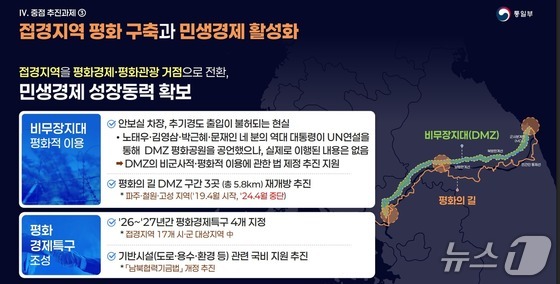
The Ministry of Unification recently announced its commitment to continue efforts to legislate on the peaceful utilization of the Demilitarized Zone (DMZ), despite ongoing tensions with the United Nations (UN) Command. It aims to strengthen inter-agency policy coordination to present a unified government stance and will engage in thorough consultations with the UN Command through various channels, including the Ministry of Legislation.
Based on the Basic Plan for Peace Economic Zones, the ministry intends to designate four peace economic zones between 2024 and 2027. Local governments will submit development proposals for review and approval by the Peace Economic Zone Committee. To mitigate the impact of regional tensions on border communities, the ministry will establish a public-private consultative body involving local residents to gather input and develop effective measures.
The ministry also plans to create a public-private consultative body involving residents in border areas who have faced challenges due to North Korean propaganda broadcasts, aiming to develop effective support and mitigation strategies.
Addressing the lingering effects of division and pressing humanitarian issues, the ministry aims to expedite the resolution of cases involving 34,000 separated families, 100,000 war abductees, 516 post-war abductees, 7 detainees, and 60,000 Korean War prisoners of war. These issues, previously discussed during the 2018 inter-Korean summit under the Moon Jae-in administration, will be prioritized as key agenda items in future summits.
For long-term prisoners who have requested repatriation to North Korea, the ministry plans to facilitate third-country transfers led by private sector initiatives. During the work report, President Lee suggested issuing passports to these individuals to enable their return via third countries, a proposal that Minister Chung confirmed is under active consideration.
The Ministry of Unification revealed alarming statistics showing that the suicide rate among North Korean defectors is twice that of the general South Korean population. In response, it has committed to strengthening mental health counseling and job support programs. From 2021 to 2023, there were an average of 54 suicides per 100,000 North Korean defectors, compared to 26 per 100,000 in the general population.
Acknowledging the negative connotations associated with the term defector, the ministry is currently gathering public input to potentially rebrand this group as Northward Migrants. The government and local authorities will initially adopt this new terminology, followed by private organizations, with a final review for potential inclusion in legal frameworks.
The ministry announced plans to amend the Unification Education Support Act to foster national consensus on peace and unification and to enhance social dialogue. It also aims to establish a legal foundation to improve public access to North Korean media, including the Rodong Sinmun newspaper and North Korean broadcasts.
President Lee questioned the rationale behind restricting citizens’ access to North Korean media like the Rodong Sinmun, asking if it’s afraid the citizens will be swayed by North Korean propaganda and become reds. He argued that allowing access to North Korean media would actually help South Korean citizens gain a more accurate understanding of the realities in North Korea.