

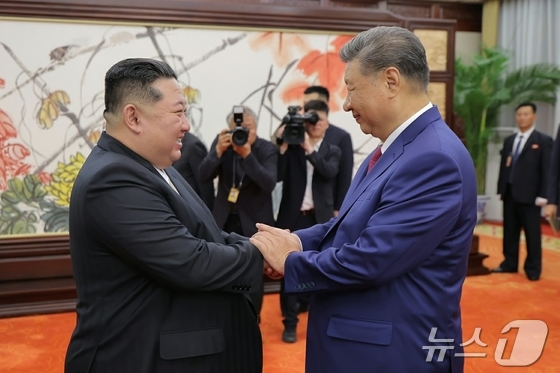
In September, North Korean leader Kim Jong Un attended China’s 80th anniversary celebration of its victory in World War II and held a summit with President Xi Jinping. Experts now report a notable strengthening of economic cooperation between the two nations since this meeting.
On Wednesday, Yoo Hyun Jung, a senior researcher at the National Security Strategy Institute, released a report titled “Changes in China’s North Korea Policy and Implications After Victory Day.”
Yoo observed that Sino-North Korean relations, which had cooled following Pyongyang’s closer ties with Russia, are now rebounding, particularly in the economic sector, after Kim’s visit to China. She suggests this reflects Beijing’s strategy to increase its leverage over North Korea, potentially using it as a bargaining chip in future conflicts with the United States.
China has recently been focusing on forming an anti-U.S. coalition, primarily through its close ties with North Korea and Russia. This was evident at the Shanghai Cooperation Organization (SCO) summit on August 31 and September 1, where they adopted the Tianjin Declaration to counter U.S. unilateralism. Days later, on September 3, at the Victory Day parade, leaders from North Korea, China, and Russia demonstrated their unity on the world stage.
Yoo predicts that as U.S.-China tensions escalate, North Korea’s strategic value will rise. She anticipates that China will pursue a comprehensive strategic support package with North Korea, encompassing not only general trade but also improvements in tourism, transportation, healthcare, construction, finance, and telecommunications infrastructure.
However, analysts believe that China’s conciliatory approach toward North Korea will likely remain limited to economic matters and won’t alter Beijing’s stance on denuclearization of the Korean Peninsula.
Yoo argues that the principle of denuclearization aligns with China’s strategic interests and will likely remain unchanged. However, she expects China to shift the responsibility for concrete denuclearization steps onto South Korea and the United States, rather than taking action itself.
Furthermore, Yoo suggests that the U.S. might also consider using North Korea as a geopolitical card to weaken China’s regional influence.
This aligns with a 2022 recommendation from the U.S.-China Economic and Security Review Commission (USCC), which advises Congress, suggesting that the strategic rift between North Korea and China should be leveraged as part of the Indo-Pacific strategy.
Yoo said that if the U.S. were to offer conciliatory measures to North Korea, Yoo predicts these would likely focus on economic cooperation. Potential developments could include tourism infrastructure projects, such as the Wonsan Kalma coastal tourist area, which former President Donald Trump mentioned, or a critical minerals agreement between North Korea and the U.S.
Yoo advises that the South Korean government should propose that China emphasize the need for improving inter-Korean relations during the South Korea-China summit. Additionally, she recommends strengthening practical discussions with the Trump administration.