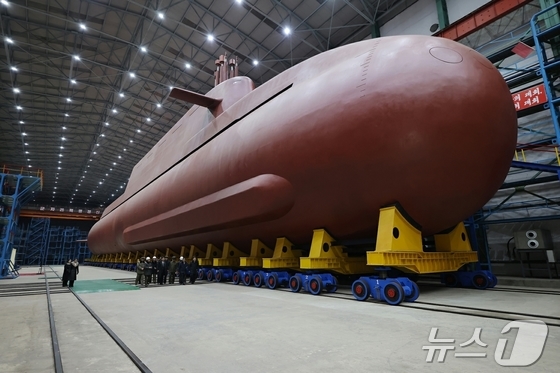
On Thursday, North Korea unveiled the complete hull of its 8,700-ton nuclear-powered submarine for the first time. This move appears to be a strategic response to the recent agreement between South Korea and the United States to introduce nuclear submarines, with practical negotiations set to begin early next year.
North Korea’s state-run newspaper, Rodong Sinmun, reported that Kim Jong Un personally inspected the construction of what it described as a nuclear-powered strategic missile submarine. The newspaper released the first full photograph of the submarine under construction, a significant escalation from March, when only part of the hull was shown. The latest disclosure appears intended to demonstrate that the project is nearing completion.
The North Korean submarine reportedly displaces 8,700 tons, surpassing the U.S. Navy’s Virginia-class attack submarines, which displace 7,800 tons. However, Pyongyang remained tight-lipped about specific details such as the reactor propulsion system, integrated armament, or internal configuration.
Hong Min, a senior researcher at the Korea Institute for National Unification, suggests that based on typical nuclear submarine construction phases, the vessel likely has key components installed, including the reactor pressure vessel, steam generator, main turbine system, reduction gear, main shaft line, cooling pump housing, and missile launch tubes. The outer hull appears to have been assembled over this internal structure.
Hong predicts that North Korea will soon launch the submarine, conducting initial tests for cooling, electrical systems, and noise reduction without nuclear fuel, before proceeding to operational testing with a fueled reactor.
By labeling the vessel a nuclear-powered strategic missile submarine, North Korea appears to be signaling its ability to carry nuclear-tipped ballistic missiles. The designation suggests it is a strategic nuclear submarine (SSBN) designed for nuclear deterrence, likely equipped with submarine-launched ballistic missiles (SLBMs) or cruise missiles (SLCMs). By contrast, South Korea is pursuing conventionally armed attack submarines (SSNs) without nuclear weapons.
Kim Jong Un emphasized that North Korea’s defense policy is based on possessing the strongest offensive capabilities, reaffirming his commitment to nuclear armament and naval modernization. Rodong Sinmun also reported on research into new underwater weapons systems and plans to expand naval forces.
As U.S.-South Korea nuclear submarine talks gain momentum, North Korea flaunts its progress, possibly with Russian assistance. The timing of North Korea’s submarine reveal appears directly linked to recent developments between Seoul and Washington. Following the October 29 summit in Gyeongju, where leaders discussed nuclear submarine acquisition, President Trump swiftly approved South Korea’s pursuit of such technology. A joint fact sheet released on November 14 further outlined the allies’ close cooperation on this matter.
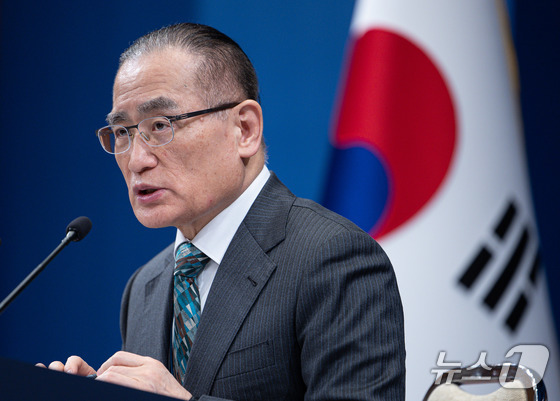
National Security Office Director Wi Seong Rak recently briefed on his U.S. visit, confirming that both sides agreed on the need for a separate agreement on nuclear submarine cooperation. This indicates significant progress in the discussions.
Wi also stated that the presidential office is committed to accelerating the implementation of leadership agreements. He announced that a U.S. working-level delegation would visit South Korea early next year for security discussions, signaling the formalization of bilateral talks on the acquisition of nuclear submarines.
North Korea appears to have ramped up its submarine construction efforts following the U.S.-South Korea agreement. Experts speculate that Russian technical support may have played a role in this accelerated progress.
Notably, Rodong Sinmun published a letter from Russian President Vladimir Putin on the same day as the submarine reveal. Putin’s message, originally sent on December 18, praised North Korean soldiers’ role in liberating Russia’s Kursk region and emphasized the unbreakable friendship between the two nations. The letter also stressed the need for cooperation on international issues and for establishing a just multipolar world order.
The timing of Putin’s letter publication, coinciding with North Korea’s submarine reveal, is seen as significant. Analysts suggest it underscores a multilateral power dynamic, with North Korea potentially leveraging Russian support to counter the U.S.-South Korea alliance.
Kim’s submarine reveal also follows President Trump’s December 22 announcement of the Golden Fleet initiative, aimed at countering China with new large aircraft carriers. A U.S. nuclear submarine’s port call in Busan on December 23 further contextualizes North Korea’s actions, potentially reflecting a coordinated response within the North Korea-China-Russia axis.
While experts estimate North Korea needs another 4-5 years to operationalize its nuclear submarine fully, the pace of development appears rapid compared with South Korea’s projected 10-year timeline. Given North Korea’s recent rapid advancement in naval technology, including a new 5,000-ton destroyer, Pyongyang is likely to intensify efforts to complete its nuclear submarine program, aiming to bolster its deterrent capabilities against South Korea and the United States.