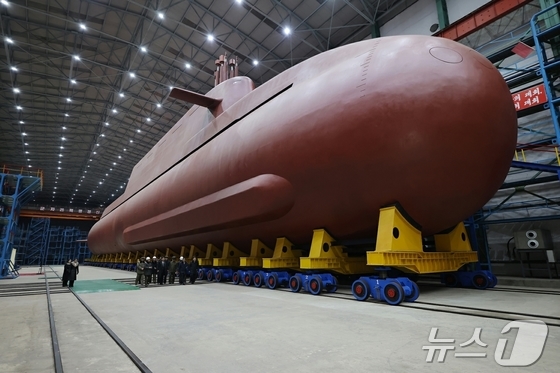
North Korea has unveiled its 8,700-ton nuclear-powered strategic guided missile submarine for the first time, saying it is under construction. This disclosure suggests that Pyongyang has reached a critical milestone in its nuclear submarine program. The vessel, believed to be equipped with internal systems including a compact nuclear reactor, has sparked debate among experts over its operational timeline and capabilities.
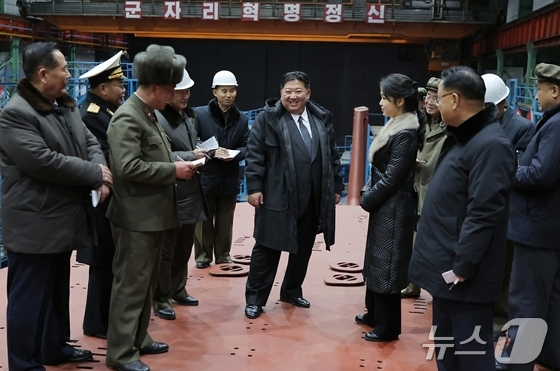
On September 25, the regime’s official newspaper, Rodong Sinmun, reported that Kim Jong Un personally inspected the submarine’s construction. The designation strategic guided missile submarine indicates that North Korea is likely developing a ballistic missile submarine (SSBN) capable of launching nuclear-tipped missiles. This differs significantly from South Korea’s pursuit of conventionally armed attack submarines (SSN).
Representative Yoo Yong Won, a former military correspondent, noted that the 8,700-ton displacement falls between Western SSBNs and SSNs. He assessed that North Korea appears to have fitted the submarine’s sail with 10 submarine-launched ballistic missile (SLBM) tubes.
Yoo described this configuration as abnormal, emphasizing that it is highly unusual for a submarine’s sail to house such a large number of SLBM tubes. He said the oversized sail suggests North Korea is making a desperate attempt to accommodate large SLBMs on a nuclear-powered submarine.
The lawmaker speculated that the submarine could carry untested Pukguksong-4 or Pukguksong-5 SLBMs, or possibly a new SLBM model showcased at the “Defense Development-2025” exhibition. Yoo believes North Korea is developing this submarine to ensure a second-strike capability, allowing it to launch a retaliatory nuclear attack from hidden underwater locations if its mainland is hit.
Nuclear submarines offer a significant tactical advantage over diesel-electric boats, as they can remain submerged for much longer periods, making them more difficult to detect by adversaries.
Hong Min, a senior researcher at the Korea Institute for National Unification, assessed that the submarine likely houses key components, including the reactor pressure vessel, steam generators, main turbine system, reduction gears, main shaft, primary coolant pump housings, and missile launch tube structures. He believes most internal systems are in place, with the outer hull now assembled. Hong expects North Korea to launch the submarine soon, conducting noise and vibration tests without nuclear fuel before proceeding to sea trials with a fueled reactor.
Hong also suggested the submarine might employ a mix of strategic cruise missiles (SLCMs) and SLBMs. Cruise missiles, flying at low altitudes, are harder to detect by radar and ideal for surprise attacks.
The Korea Defense and Security Forum (KODEF) identified six horizontal torpedo tubes in the bow, in addition to the potential for 10 SLBM tubes. They noted sonar arrays on the hull, indicating a design leap beyond North Korea’s Romeo-class diesel submarines. KODEF also spotted what appear to be new, quieter torpedoes and naval mines in photos released by Pyongyang.
Most analysts agree that North Korea’s nuclear submarine program has progressed faster and further than anticipated, raising questions about possible Russian assistance with small reactor and weapons technology.
However, Yoo Ji Hoon of the Korea Institute for Defense Analyses (KIDA) cautions against jumping to conclusions about North Korea’s nuclear submarine capabilities. He emphasized that nuclear submarines are complex integrated systems that combine hull design, reactor technology, underwater safety systems, crew expertise, and maintenance infrastructure. Yoo stressed that photos alone are insufficient to determine the submarine’s readiness or deployment timeline.
Yoo added that key details, including the claimed 8,700-ton displacement, the reactor’s capabilities, the exact nature of the strategic guided missiles, and the submarine’s actual missile launch capacity, all require independent verification. He concluded that significant time may still be needed before the submarine becomes operational.